Friday, August 14, 2020

Balancing In-Person and Remote Learning: The Hybrid Model

Most conversations about reopening schools include the hybrid model. This mix of in-person and remote instruction can have many varieties, including 2 days of in-person learning and 2-3 days of remote learning each week, with students split into two teams and alternating the days they are in-person. Other schools are opting for one week of in-person learning alternating with a week of remote learning. While I can only imagine just how much thinking and effort has been undertaken by local districts across the country this summer to implement these models, it does seem like there are some unspoken assumptions driving particular plans. Below I describe what a hybrid model might look like if learning, child care, or transportation and space constraints were prioritized. Though this is a thought experiment, I do think it’s helpful to point out the affordances and challenges of these priorities in order to question whether we’re pulling on the right levers, and which levers we’re not even touching.


Priority: Student Learning

We all learn through interaction and thrive on routine. My earliest posts for this blog highlighted these themes of learning being a social endeavor. So regardless of the learning environment, ensuring opportunities to learn with and from others, with the support of a teacher, is critical. With this in mind, allowing students, particularly our youngest students, to have as many touch points with their teacher seems obvious. Similarly, having the same teacher and a consistent group of peers also seems like an obvious component of a successful learning environment. (This report from the spring sadly notes that only 33 percent of students had regular access to teachers, 15 percent of parents received personal guidance about how to support their child, and just 13 percent of students got one-on-one time with their teachers.) And keeping a schedule as routine as possible is also advisable.

But which of the hybrid options seems to prioritize these components? None of the ones I mentioned above. Instead, half days for two groups of children would accomplish most of these goals. With half days, the same teacher instructs the kids each day of the week and sets them up with independent or project-based group work that they can continue at home. Instructions and support are largely given during the face-to-face time in school and parents are given information to support extended versions of homework. In typical elementary schools, much of the day is spent establishing routines, transitioning, doing independent reading or math work, or working with a partner or in a small group to complete an assignment. Half days are ample time for the instruction a teacher wishes to impart and for checking in with students individually to ensure they are set up for success at home. This model might be a 4-day model with an entirely remote day that allows the full group of students to interact synchronously online for part of the day and then continue with the extended homework for the remainder of the time while the teacher can engage in professional learning and sharing with colleagues around what’s working or what challenges they are facing. While not unique to this model, it also allows for the use of other adults, like special educators, counselors, reading or math specialists, assistant teachers, student teachers, or paraprofessionals to support smaller groups of students both in-person and remotely, and for these other adults to have time to meet with the teacher to discuss any concerns or struggles of individual students. So why is this model not being implemented anywhere? Mainly because of childcare, which brings me to the next consideration.

Childcare

If the hybrid model were to be designed with childcare needs as the highest priority, a consistent schedule that allows for longer chunks of time in school buildings would be optimal. This is largely why we are being offered the 2 full days per week or one week on, one week off models. While this does support working parents to an extent, it’s still a logistical nightmare for any full-time employee. Work does not stop for the 3 days each week the child is home, or for the week when children are home. (And of course there are parents who are the actual teachers too!) And on top of the inconsistent schedule for parents, children have an inconsistent learning schedule as well as inconsistent teachers.

There has been much said about how schools are not daycares. However, implicit in the model of schooling that has existed for over a century is the fact that schools are in fact caring for children while educating them. Ellen Gallinsky, the chief science officer at the Bezos Family Foundation said, “Indeed, the divide between child care and education contradicts our current understanding of child development.” Of course we’d all be up in arms if schools merely supervised children without teaching them. This is why they are not simply daycare centers. But on the flip side, we don’t choose daycare centers without enriching environments either, if we can avoid it. Needs for learning change over time--toddlers need supportive adults who can create environments for safe exploration while elementary and secondary students need structure, resources, and experts in pedagogy to impart complicated concepts, critical thinking skills, and executive functioning capabilities--but these are both equally learning-based environments based around supportive relationships with caregivers. Randi Weingarten, the head of the American Federation of Teachers, notes, “The driving force for education should not be ‘a parent needs to have a place for her kid to be so she can go to work’. We need to have an answer to that question, which is not school.” Well yes, but if that were the entire story, then wouldn’t we be prioritizing learning and choosing a different hybrid model?

Transportation/Space

If there were enough transportation for everyone to ride a bus at a social distance or for students to be housed in learning spaces with enough room to be socially distant, then perhaps there wouldn’t be these conversations in the first place. But the reality is that there are not enough buses and drivers or classroom spaces to allow for this. That’s how we’ve ended up in the current bind. Public education is bound by many regulations that make creative possibilities extremely constrained here, so this section may be pointless. But for the sake of beating my head against a wall, let’s imagine a possibility for creativity. What if we could explore common public spaces, like libraries or community centers or even abandoned schoolhouses? What if some of the government pandemic spending went to renting out commercial spaces that are currently empty because of forced closings during COVID? What if we recognized that secondary students are more capable of remote learning than elementary students and we converted high schools into more early childhood spaces? This is all to say that there could be ways of finding space if there were room to explore (pun intended). Of course, national leadership in this realm could be helpful. (And that’s as political as I wish to get!)

Wednesday, August 5, 2020

Instruction Renovation and Innovation

When school buildings suddenly closed in March, educators and parents were thrown into totally new educational waters. They tried to tread water and cling to rafts, keeping themselves and their students and children afloat. But now we’ve had a whole summer to contemplate this reimaged landscape. And as plans for the new school year are beginning to be floated (I do like a good extended analogy), many of us are trying to figure out how to swim with the rip current.

This instructional renovation is going to require a lot of innovation. And while this remodel is still emerging, it is clear that in-person versus remote teaching is not the only consideration. Regardless of learning environment, there are key considerations around the best uses of synchronous and asynchronous teaching and learning; the importance of non-cognitive skills to successful learning; and the need for children to have social interactions and emotional support. (There are also individual student needs by grade level, family situation, and learning factors, as well as the sociological shifts in schooling due to the pandemic, but let’s not get carried away!) For now I’m mostly raising questions within each of these areas to begin a conversation building our collective wisdom to inform the infrastructure of this new enterprise, but I do hope to think more deeply about each in subsequent posts in the hopes of supporting wading through the floodwater of information in making a decision for your children and family.

Synchronous and Asynchronous Teaching and Learning

Thinking about ways of learning that are best suited to in-person instruction, how might this translate to live virtual teaching in terms of maintaining interaction through the screen (e.g., nonverbal signals)? What digital tools can support breaking into small groups to continue effective pedagogical practices (e.g., think/pair/share)? Similarly, what kinds of instruction are best suited to asynchronous remote learning (e.g., project-based learning activities or recorded activities that build home routines like The Listening Song)? Research over the last decade on the flipped learning model can also provide guidance on the balance between live and recorded instruction. Furthermore, we know there are challenges of limited broadband internet or device access. How can these challenges be overcome (e.g., PBS programming)?

Non-Cognitive Skills and Habits of Mind

We know the importance of non-cognitive skills (e.g., executive function skills like time management, prioritizing assignments, maintaining focus and avoiding distractions) for academic success generally, but they are critical when learning happens independently or remotely. How can in-person or virtual teachers (or other adults) support students in developing and applying these skills? Common Sense Media recommends these apps, but many parents with sufficient means are resorting to pandemic pods so their kids can have meaningful engagement in educational activities without the support of a working parent. How can schools utilize this idea to support remote learning while also avoiding the inevitable inequalities resulting from such experiments outside of the public school system? For example, school staff and community volunteers might be leveraged to enable a consistent adult to support, engage with, and monitor a small group of students. Professional development time could be used to build a community of these small group leaders to effectively work with their students in building these essential skills.


Schools are not just for academics. They also provide opportunities for socializing and emotional support (not to mention child care!). While some students have thrived in the absence of the pressures associated with peer interactions and the opportunities for more individualized participation (e.g., private recordings to teachers with tools like Flipgrid), many students are missing friends and parents are desperate for other adults to support the emotional turmoil their children are experiencing. Furthermore, the pandemic and the heightened awareness of racial injustice have increased these needs for many students. What risks arise for students who typically rely on traditional classrooms for critical support? What structures and systems can be put in place to highlight the affordances and mitigate the risks of remote learning for individual students? How do we adapt these ideas for students at different grade levels?

Tuesday, July 21, 2020

Turning Planning for Summer On its Head

In my most recent post, Planning for Summer, I offered ideas for structuring open-ended summer time using checkboxes. I also suggested attaching screen time to checking off boxes in order to motivate kids to keep up with productive and educational opportunities. While this system was working for us, I also worried about unintended consequences. Like many reward systems, things that one might have done anyway or out of interest get turned into things to get through to earn a reward. I saw my kids scheming about the fastest and easiest ways to check off boxes rather than diving into things they normally would have done and enjoyed. So before I inadvertently eliminated all of their intrinsic motivation by offering extrinsic rewards, I took a different approach.

A year or so ago, my husband and I noticed we were having nightly battles with our kids about how much of their dinner they needed to eat to get dessert. How had we turned into the stereotypical parents we swore never to be? He had the idea of deciding on what a reasonable amount of dessert would be and making it available regardless of all other consumption for the day. So even if you don’t eat the broccoli at dinner, you can still have a cookie or a scoop of ice cream. For most of us, this freed us up to actually try more things, linger over the meal more, and not place more value on the dessert than the dinner. (One of our kids remains a very picky eater, so I certainly do not proclaim to have all the answers!)

Building from this same approach, we decided that 1 hour of screen time each day was an amount we felt comfortable with, regardless of what happens during the rest of the day. So we separated screen time from the checkboxes. Instead, screen time was added to the list for the day, and the boxes were reframed as boredom busters to be chosen rather than responsibilities that were non-negotiable. Suddenly they seemed more appealing!

We did have a conversation about this switch with our kids, discussing which boxes would be easy to continue checking off and which ones would be harder for them to motivate themselves to do (chores!). We did not say that all boxes had to be checked daily, but we did remind them of our expectations of being a part of a family team. We said we’d circle back at the end of the week to see how things were going. Not surprisingly, our avid reader was reading a ton. But our more reticent reader was finding times within the day to read in shorter bursts--to his younger sisters or to himself--and was actually enjoying it more since he wasn’t setting a timer and getting through a reading session. I was enjoying being able to ask for help with things more in the moment, rather than trying to come up with helpful things in bursts so they could get to their videos and then refuse to help me later when I needed help with something else. It seemed like a win-win.

This whole experiment also got me thinking about what I value and pass on to my kids. Why was reading a check box but not math games or puzzles or calling a friend or drawing? Marion broached this topic in her earlier post about Skipping the Vernal Pool. I know we pass on our values in all we do and often don’t even notice we’re making these choices. So I’m glad I am at least questioning it. Again I don’t have all the answers, but as I think about the upcoming year and the very real possibility that parents will continue to be managing a lot of time with our children, I can imagine including my children in a conversation about values in much the same way that teachers might include their students in a conversation about classroom culture and expectations. What feels important to them? What are they interested in and motivated to do? What are their own aspirations? What do they want to do for others? What do they wish from others? What are they avoiding, perhaps out of worry or feelings of inadequacy? What is something new they might like to try? What might make something easier to try or harder to share with others? I’m sure we all would have our own ways of asking. I don’t have all the questions either!

Tuesday, June 30, 2020

Planning for Summer

With July upon us, summer is in full swing. School ended and we took a week off from everything, enjoying being Unplugged. But then I felt a need for some kind of structure to the open-ended days that lay ahead of us. I wanted a way to harness my kids’ potential for finding fun and being creative while still maintaining the freedom and spirit of summer and allowing me to remain a step ahead of the stream of questions about what they could do. And I’m not going to lie, if they could keep up some learning activities, that wouldn’t be too bad either.

I do love a good checklist, so that’s where I started. Our daily chart has 5 boxes with minimum time requirements (more is always allowed):

  • Music: 15 minutes
  • Household help: 30 minutes
  • Reading: 45 minutes
  • Movement: 1 hour
  • Other (arts & crafts, puzzles, games, writing, building, etc.): 1 hour

Then I sprinkled in some motivation. Checking off 2 boxes earns you 30 minutes of screen time. If your kids are like mine, they will already have figured out that they can check off 4 boxes and have an hour straight on screens, and that if they combine efforts and do each of their hours back-to-back, then they can watch a movie. If your kids are also like mine in their eating habits, then you may have to require eating meals before doing screens. (And you probably notice this doesn’t fill the day. That’s intentional so that they can practice filling their time. These boxes can be great starting points.)

I have to say that my favorite part of this chart is the household help. The kids have always had chores that took them less than 10 minutes to do. So now I have 20 minutes of their help each day for things that I was always scrambling to fit in before the twins sprinted down the driveway or dumped out the toys we just cleaned up or decided to eat yogurt with their fingers and then hop like frogs around the house. I was inspired by this podcast with Dr. Deborah Gilboa, a parent of 4, family medicine doctor, and parenting advice giver extraordinaire, where she gives great actionable tips about how to keep kids engaged in helping around the house and is totally clear on why this is so important. Here are some of the amazing things I’ve discovered my kids are quite capable of doing on their very own:

  • Making and packing lunches for everyone (turns out they can make pasta, eggs in several varieties, sandwiches…)
  • Loading and unloading the car with bikes, scooters, and helmets
  • Gathering towels and floaties, and then hanging them up to dry when we get home 
  • Cutting vegetables, opening cans, and even following a recipe to make soup for dinner
  • Resupplying bathrooms with toilet paper or bedrooms with tissues

As always, flexibility is key. If we go out for the day, we don’t make a chart or worry about it. Most likely we’ve been hiking or swimming and everyone is tired, and relaxing with screens for half an hour is in everyone’s best interest. I’ve also been trying to have a weekly outing, inspired by my summer camp days with weekly field trips. It’s nice to break up the stream of summer days that can leave you forgetting what day it is, and it also gets everyone out of the feeling that there are no new choices available. Even if you don’t have the flexibility to take your kids somewhere, you might think about how to make one day “special” during the week, perhaps with pancakes or a longer project (talent show anyone?) or bedtime stories under the stars.

And speaking of shaking things up, that “Other” checkbox category is probably your ticket to never having to answer the question, “What can I do?” or respond to, “I’m bored!” Here are some ideas for that box, which may even take the form of a jar with suggested activities that kids can choose randomly:

  • Wide Open School by Common Sense Media has virtual summer camp ideas and activities, as well as schedule templates for you to use in planning for your family
  • TED-Ed has tons of short video lessons for kids on interesting topics that might spark ideas for a creative project or investigation, or simply make for some interesting dinner conversation
  • The Boulder Public Library does a great toddler/preschooler story time, and they’re posting all their episodes so it can become a part of a routine that your kids get to know over time. Many local libraries have similar programs and even suggested crafts to go along with the theme of the stories.
  • Even young children can play independently, and here’s a short piece with tips on how to encourage it
  • Mommy Poppins put out this list of 100 activities for kids this summer that don’t involve screens
  • PBS Learning Media Camp activities for pre-K to 2nd graders and for older students to keep learning fun and alive during the summer
  • Finally, some thoughts about virtual camp and a list of ways to make happy campers from home!

Friday, June 26, 2020

Noticing and Acting on Difference

In this NY Times article, How to Raise an Anti-Racist Kid, the author emphasizes the starting point of talking, noting that we should not shy away from comparing and contrasting people, experiences, media, interpretations, reactions, and ideas in order to focus on the differences. (Speaking of which, this Nick News with Alicia Keys on 6/29 should be a great conversation starter!) While focusing on differences may seem obvious now (after all, variety is the spice of life!), it wasn’t always obvious to me, and it’s definitely not comfortable to me yet. Different means change, and change is hard.

In my own life, I notice myself being stuck in the same interactions. Why do I keep having this same fight? Why do I keep putting other people’s needs ahead of my own? Think of what being “stuck” looks like for you. I’m sure it’s there because, after all, we’re only human.

I’ve been doing a lot of thinking about some of my “stuck” points, and I keep coming back to the need for trying something different. And more and more I’m realizing that different is just that: different. It doesn’t have a judgment attached to it. It’s more of an observation, or something to experiment with. Doing something different is pretty likely to lead to a different outcome. For example, try meeting that person in your argument with curiosity, or try saying no to something you might have normally said yes to. See what happens. My husband shared this Autobiography in 5 Chapters by Portia Nelson with me that captures this so well:

Chapter 1: I walk down the street. There is a deep hole in the sidewalk. I fall in. I am lost. I am helpless. It isn’t my fault. It takes forever to find a way out.

Chapter 2: I walk down the same street. There is a deep hole in the sidewalk. I fall in. I am lost. I am helpless. It isn’t my fault. It takes forever to find a way out.

Chapter 3: I walk down the same street. There is a deep hole in the sidewalk. I see it there, I still fall in. It’s habit. It’s my fault. I know where I am. I get out immediately.

Chapter 4: I walk down the same street. There is a deep hole in the sidewalk. I walk around it.

Chapter 5: I walk down a different street.

I love this quick description of life. And just like with our other “stuck” points in life, it’s incredibly applicable and powerful within the context of institutional and systemic racism. We’re going to keep walking down the same street and falling in that same hole if we don’t open our eyes to the hole and do something different. And though it takes time to even notice the opportunity to do something different, once you see a different path, there’s no going back down that same street again.

I also really appreciate that this autobiography starts in observation and lack of responsibility and ends with agency and action. One of the people quoted in the article from the start of this post said: “Don’t frame anti-racist work as an extracurricular, but rather as an integral part of life...Art, coding, policy, statistics--all of these can be harnessed for anti-racist work on a daily basis.” To really make change requires commitment, putting intention and action together to do something different.

This also got me thinking about Carol Dweck’s revolutionary idea of growth mindset, that believing one can learn and improve allows one to put in the effort required to actually learn and improve. Like anti-racism, it’s a pervading idea and way of life that cannot be siloed into a specific context. Just as I said at the beginning that change was not comfortable to me yet, I can work at it and grow in my relationship to change. The same is true of anti-racism. It may not pervade my everyday experience yet, but I can work at it and I can change. Like this Mom of All Capes on a new podcast I’m enjoying points out, we have the power to “turn talking into action” and to see that “the world isn’t falling apart; it’s coming together.” Let’s notice our differences, see our opportunities to try something different, and put in the effort to be a part of that change!

Thursday, June 18, 2020

There Are No Stupid Questions

You know the adage, “There are no stupid questions, only stupid answers.” I’ve found myself wondering about that lately. I have a lot of questions, and I’m worried to ask some of them because it makes me vulnerable. Vulnerable to exposing my ignorance, to being met with criticism or disdain, or being told that my question is hurting someone else. In effect, feeling humiliated, or even worse, being mean. In that context, it feels hard to believe there are no stupid questions.

Then I listened to this powerful conversation with Lama Rod Owens on Dan Harris’ Ten Percent Happier podcast. It is long but well worth the listen. One of the points he gently offers is that a big challenge of difficult conversations is when one or more participants ignore the relevant feelings that are present within the conversational space, and instead remain in the intellectual realm. In the context of race, this might look like a white person asking questions to try to understand the Black experience at a cognitive level while remaining separate from the emotional level, which may be where the experience largely exists for that Black person. When the people conversing are in different realms, they fail to connect in a meaningful way. A safe space is not provided for actual talking, listening, learning, growing, and building a relationship.

So, maybe it does turn out that there are stupid questions? Just kidding! I don’t think it’s the question that is stupid, nor do I think “stupid” is a helpful label. So I’ll try to stop using that word, just like I ask my kids on a regular basis. Like Lama Rod points out, the feelings matter. How we ask a question has a lot to do with our emotional intent, and how we hear a question or receive an answer also has a lot to do with the emotional state we’re occupying.

This all makes me think of shame and defensiveness. Feeling shame can help us, while being shamed is likely to do the opposite. I listened to Brene Brown’s podcast with Ibram X. Kendi on anti-racism. It’s amazing, and has this valuable metaphor in it: Racism is raining down on us, and powerful people are raining it. But these same people are telling us we’re dry, when in fact we’re wet. Along comes someone who offers us an umbrella. To feel shame is to suddenly realize we are wet. But we can still accept the umbrella and thank the person offering it to us.

In this metaphor, we (or I, as a white person) are not even asking a question, and by not asking, we have been complicit in a system of racism that we may not have even known existed. However, once we are offered the umbrella, we can either feel the shame of not having ever asked the question (Am I wet?), or we can be defensive (I’m dry) and continue to perpetuate a racist system, but now a little less blindly. At that point, the questions, no matter how “stupid” they might seem, need to be asked so that one is at least in the conversational space. And once we step into the arena, as Brene Brown would say, we begin to break the cycle of being both the victim and perpetrator of racist propaganda.

Similarly to not asking uncomfortable questions, silence can send a message of shame, regardless of whether or not that was our intent. For me, I have experienced this in the world of fertility. You might have family or friends who hide their sexuality in this way. Sometimes it feels like it’s up to the person assumed to be experiencing the shame to take control of sharing or explaining, like we might put people on the spot or be insensitive by bringing up uncomfortable subjects. But for me, I welcome the questions because it gives the opportunity to celebrate something beautiful and wonderful that brings me pride. But getting there definitely took some emotional work. I imagine it might be similar in racial conversations. Questions may actually be welcomed and answers received openly once some emotional work has been done to trust the conversational space.

So where does that leave us? Getting back to Lama Rod, I think it leaves us creating safe spaces for questions and conversations and building relationships. And in building those relationships, uncomfortable topics will not only become more comfortable, they will also become more pressing and personal, and impossible to ignore. I already wrote about updating media to be more representative and inclusive, which I think is a huge step towards educating ourselves about history and the typical experiences of other people, from their perspectives. And that helps a lot with the emotional work of asking questions from a place of empathy and receiving answers without defensiveness. But then I think we need to make it a bit more personal in order to find a place of action. And while personal is necessarily individual, here are a couple of my own thoughts:

  • My kids were walking with their friends in the neighborhood and came across a house with 3 dogs, 2 white and 1 black, playing outside. My oldest son commented on how hard it is to imagine treating the black dog differently than the white dogs. His friend agreed, “I mean, they’re all dogs. How could you treat them differently?” Obviously I don’t want to equate humans and dogs with this example, but I do want to point out that this experience brought this topic to the personal level for them in a way that they could talk about it, empathize with the arbitrariness of racism, and have some thoughts about unfairness that might percolate for them and perhaps lead to some action.
  • Books and other media can bring up uncomfortable topics and can model language for having difficult conversations. I’m a huge fan of podcasts, as you might have noticed. In this Parent Trapped conversation with Allison Briscoe-Smith, she brings up the parallel discomfort you might feel in a conversation with your kids about sex and in a conversation about racism. Even though it’s uncomfortable, we can agree that it would be irresponsible to not have a conversation with your child about sex, and the same applies to racism. And she notes that starting with your children’s questions and being alert and sensitive to their reactions and discomfort is also important. For me, listening to podcasts about talking to kids and having conversations about racism and social injustice is helpful in thinking through and imagining such conversations, preparing me for some of the emotional work of being in such conversations, and framing the importance of having the conversations amidst the discomfort. And she concludes by noting the importance of emphasizing resilience and how far we’ve come and how far there still is to go, which in itself is a call to action.

Monday, June 8, 2020

The Learning that Cannot Wait

For my family, this is the final week of school. Wherever you are, some version of school has likely already or will soon be coming to a close for summer break. We’ve heard about summer slide and there has been amplified worry over the COVID slide, given the loss of learning that has already happened from disrupted schooling this spring.

I had already been gathering thoughts about ways to stay engaged and learning this summer, while still feeling the fun and freedom of summer. I had been returning to my ideas around sparking curiosity with media and engaging in project based learning. But suddenly it is abundantly clear that there is learning that cannot wait around social justice and racial inequities.

Media is helpful for creating meaningful and engaging learning opportunities. It often has fun and playful contexts that are motivating and can facilitate and accelerate skill building. It can build from prior experiences or create a foundation from which to build skills in new contexts.

With all of that in mind, below are some media resources for getting started. I hope you will spend some time being thoughtful about the books, movies, games, and experiences you select to specifically engage your children and family for maximum impact. You may have seen the saying going around about resistance not being a one lane highway. Think about what lane you and your family are currently in (having conversations, understanding the messaging in language, making signs, joining protests…), as this is the best way to ensure you will actually engage your energy in a sustainable way. My hope for my own family is that books will shine a light on new perspectives, paint new characters from different backgrounds, share new lessons and draw from rich histories that are different from our own. From there, we can question, listen, understand, and seek out more. We can be spurred to action and broken from our silence. And just like with reading and math, we must use it or lose it to avoid that backward slide towards complacency.

  • NPR’s Talking Race with Young Children: You might listen to this episode with your children, as it helps start the conversation about skin color and other physical differences rather than avoiding it. Beverly Daniel Tatum and Jeanette Betancourt (who were also on the Sesame Street/CNN Town Hall) are featured speakers, and I really appreciate their clear, child-friendly language and messages.
  • Social Justice Books, referenced on the Sesame Street Town Hall by Beverly Daniel Tatum, has book lists by age group and around specific areas of social justice, and is also a great place to start conversations and educate yourself around race, racism, anti-racism, and social justice.
  • There are so many other book lists, like these by Common Sense Media for younger kids, The Brown Bookshelf, The New York Times, Black Books Matter, and even Little Passports, so you should be able to find some books that work for you. And one thing I appreciated in these lists is that, while some of the books are on the topic of social justice, many of them are fictional or non-fictional accounts about the experience of Black children and families, or even fantasy stories by Black authors, like this Tristan Strong Punches a Hole in the Sky that I ordered for my Percy Jackson fan.
  • While Daniel Tiger definitely targets our youngest viewers, this episode on Not Hurting Your Friends, with this song in it, just feels so applicable to everything right now: “Stop, stop, stop. It’s okay to feel angry. It’s not, not, not okay to hurt someone.”
  • This PBS blog post gives ideas on sparking conversations about Black history through art and stories.

Tuesday, June 2, 2020

Different Stages of Grief

I wrote a post last week about the loss of normalcy during the pandemic and the potential for growth. And then the White world awakened to the reality of racial injustice, deciding there was no more time to sit on the sidelines and wait for change, and that everyone was a part of the solution. The post I was planning seemed tone deaf, and a new one seemed needed. While I cannot profess to have something insightful or even helpful to say, it does seem that we each ought to at least reckon with our feelings, our beliefs, our actions and begin to step into the arena to be a part of the solution. This is my step. It is a baby one, but a step nonetheless.

I grew up going to a Jewish day school from kindergarten through sixth grade. For seven years, I heard from Holocaust survivors who shared their first hand accounts of the fear and struggle, sadness and anger, and ultimate humanity and survival. It was simultaneously terrifying, inspiring, and confusing. Perhaps that’s why I had a need to know more. I was not a bookworm as a kid, yet I sought out books set during the Holocaust or that contained accounts from children. I had frequent nightmares of being chased by Nazis. I’d awaken and go through scenarios of how I’d play dead, how I’d run, where I’d hide, how I’d outmaneuver. And I imagined living in a ghetto, being torn from my family, marching unknowingly into gas chambers, surviving death camps. As I write this, it sounds morbid. Maybe that’s why I’ve carried forward a seemingly large sense of the sadness for those left behind. But it was the way I knew to take control of all that horrible information. I can’t even imagine what it’s like for Black children to be hearing today’s stories and living them, rather than hearing about it in the past tense and relegating the fear to the world of dreams.

Each survivor story I ever heard always had a tone of hope, that sharing their story and educating the children of the future would ensure that all they endured would be put to good use. I fear that I’ve lost sight of some of that. I’ve felt invincible, even as antisemitism has risen in the world around me. I feel safe in my bubble, and would rather not think about or imagine the scariness that exists beyond my immediate environment. I can barely even read or watch the news, let alone let it sink in. And that makes me feel so guilty because that is such a luxury.

I cannot begin to understand the experience of being Black in America. But I hear and see the injustice, I fear and feel for those affected, and I vow to work to understand and to not pretend to be invincible myself so that I can stand with those who know they can never be invisible or invincible.

A lot of our posts on this blog have to do with leading by example, supporting each other, and finding opportunities amidst challenges. I have believed that everyone has their own worries, struggles and successes, and that my own are not diminished because there are those whose worries and struggles seem so much deeper and daunting or whose successes so much harder earned. I recognize my experience is my own, but I still think there is a lot that is relatable and supportive of others’ experiences. In the area of racial injustice, I feel lost. My current worries, struggles, and successes do seem diminished in the context of what others find themselves up against. But I think it’s important that this comparative suffering doesn’t keep me silent for fear of further insensitivity. I may not know the best thing (or even the better thing) to say yet, but in speaking, I can have the chance to listen and I can learn. With this in mind, it is heartening to see the impact of this injustice being felt worldwide and the voices being lifted from all corners of the globe. This is not just a local issue, and not just a national issue but a global one. And it’s largeness feels entirely overwhelming.

I guess this is where those stages of grief from my original post may provide some helpful landmarks. Many of us find ourselves in the lands of denial, anger, bargaining, depression, and even acceptance. These are important guideposts on the journey to recognizing, labeling, understanding, and acting against racial injustice. But I believe it is the need for meaning that has the greatest potential for change.

In my own meaning-making, which is in its infancy, I find myself thinking about diversifying our children’s and our adult bookshelves with stories that represent wider perspectives, backgrounds, and contexts. We have made some efforts in this area with regard to LGBTQ literature and are proud when our kids are quick to notice that the school’s puberty video only references feelings around male-female relationships. But I’m ashamed to notice that we have merely two picture books with primarily Black characters and not many more books about the Black American experience. What about our dolls? Game pieces? Art on our walls? No wonder we don’t have many conversations around race. What would spark it?

As I continue to think about my next steps, in terms of conversations within my own family and community, I will definitely be digging deeper into online resources and tools that are geared towards supporting these conversations and deepening understanding of the experiences of others in our world. But for now, here is a starting list:

From Common Sense Media:
Trevor Noah’s heartfelt and clearly explained thoughts about the current state of society

Embracerace has great resources and articles for families

Teaching Tolerance also has great resources for educators

Wednesday, May 27, 2020

The Bumpy Ride

Another day, another metaphor. Well, a literal one this time. We went on a family bike ride, just the six of us. It was a bumpy ride.
We’ve been encouraging our now 8-year old to learn to ride a 2-wheeler for a while now. He was never into his balance bike and has been an avid scooter-er for years now. The bike had grown into a larger-than-life thing. So we stopped pushing. Our school district does a unit on biking in fourth grade, so at the latest, we hoped they might teach him. And then COVID hit, and a great way to be socially distant while with your friends is to go biking. Motivation kicked in, along with the idea of using his big brother’s bike with hand brakes and the pandemic-inspired stretched out time and space to practice something challenging. Suddenly it clicked and he could ride!

Oh the joy! He rode all day long. He told everyone he saw. He was beaming with pride. And then snap--the chain broke! This is probably not a big deal for bikers, but we are not handy with anything, including bikes. “Not to worry,” said the problem-solving side of my brain, “I’ll write out to my Facebook community to see if anyone is looking to sell a bike.” A friend came to the rescue with not just one, but two bikes, and for free! (And we got to pay it forward with our bike to a family that knows what to do with a broken chain!)

We finally had 4 bike riders, 4 bikes, and a chariot trailer for the twins, so we could do a family bike ride. Hooray! We had promised a ride to a local farm with ice cream and apple cider slushies once R learned to ride his bike. That day had arrived. We pumped tires, we tightened bolts. All this took time and fortunately the kids were patient, though it turned out they were eating granola bars with chocolate so when I looked in the trailer it looked like a literal sh** show!). Luckily I had packed wipes (and a portable potty, change of clothes, sunscreen, bug spray, snacks, and water… you know, just a few things to add to the weight of the trailer when a family goes out for a bike ride!). Off we rode! It was wonderful riding as a family. Those small hills were hard, and the sweat was pouring down, but we made it to the farm and there was ice cream and there were slushies, and there were even friends to chat with there, from a safe 6-foot distance of course!

As I took my first pedal to head home, I discovered I had a flat tire. Problem-solving time again. Luckily we remembered how to switch the trailer, so we attached it to my husband’s bike so I could ride as much as I could on the flat tire and walk the rest of the way with my bike. Well, turns out that without air in the tire, turning is a totally different ball game. I should have learned this lesson the first time I tried to turn, but it took two times to confirm that I should dismount before any turns. Luckily, no injuries. Definitely some fear on my part as well as anxiety from my oldest about my falling and about R potentially crashing into him with a sudden stop. Like I said, no physical injuries.

Long story long, we made it home. On the positive side, R persisted and learned to ride a bike. We persisted through a broken chain, fixing handlebars, dealing with a flat tire, changing the chariot attachment, and getting back up after falling. On the negative side, all of those things happened. But that is the bumpy road of life.

These days that bumpy ride seems bumpier by the day, and to be honest, I’m not always glad to be on the ride. Our persistence and optimism are really being put to the test. But, these bumpy rides are truly the stuff of which memories are made. Those bumps challenge us (I was so patient!), make us stronger (I can figure this out!), bring us closer together (remember that time…), and remind us that, no matter what bumps are in our roads, we will ride on and we are enough. So as you journey along your own bumpy road, remember that this parenting journey was already a marathon, and now is an ultramarathon, and there are hills, potholes, and cramps along the way. Those are just growing pains. There are also summits, vistas, and a great future story to tell. You got this!

Thursday, May 21, 2020

Missing Normal

I emailed my kid’s teacher asking if I should defrost the chicken. I looked in the mirror and wondered how Frida Kahlo got into my house. I haven’t worn pants with a zipper in at least 6 weeks, and when I noticed a coffee stain on my shirt I started wearing it inside out. We’ve acknowledged before that we’re not playing with a full deck these days, and these daily happenings are testament to that. Life’s not normal, and it’s taking a toll. 

This week a good friend asked what I miss the most about normal life. I miss restaurants, hosting friends, pushing babysitter curfews, getting lost in stores. Most of all I miss having plans and taking them for granted -- knowing that something’s coming up that breaks routine, often with people I feel lucky to call friends. I’ve developed a surprisingly masochistic habit of watching events pass by on my Google Calendar, refusing to delete them even though they’ve long since been cancelled. 

My kids know they’re missing important things, but fortunately still lack a good sense of time and are blissfully unaware of what was supposed to happen when. If my 4th grader knew he’d have a baseball game this weekend, he’d throw a fit. If my kindergartener knew how many birthday parties would have happened by now, he’d cry. Maybe as you get older it’s not just that your sense of time sharpens, but that you become able (or inclined) to visit that parallel life-- the one that reminds you of where you would be, what you would be doing, and who you’d be with if things were different (or, in this case, if you didn’t worry that those things would put those you love on a ventilator). 

I ask myself almost daily why I don’t delete cancelled events from my calendar. They make me sad, but I think they also serve as a reminder that our pandemic routines are not our real routines. Rather, they’re breaks from our real lives that are filled with things we can confidently look forward to. And as I imagine myself in my parallel life -- at a party, a concert, a reunion -- there are optimistic undertones to the sadness I feel, in that I know I’ll be back in that real life soon. I just can’t mark the date in the calendar.

Wednesday, May 20, 2020

Project-Based Learning

Project-based learning is a term to describe learning by doing. Its goal is often to foster approaches towards learning, like curiosity, goal setting, collaboration, persistence, and problem-solving, rather than starting with specific skills or concepts that a lesson is built around. Learning at home is a rich opportunity for this type of learning. While it can take a more “traditional'' form, like creating and running a lemonade stand, building a model volcano, or researching a planet or animal of interest and then designing an art project or report to demonstrate learning, it can also take surprising forms. Below we offer some ways we’ve engaged in project-based learning during the pandemic.

Glow Sticks Dance Party

An example from a weekend a few weeks back was the arrival of a package of glow sticks. The sender shared a clip of kids dancing like glowing stick figures in the dark, and that was the spark that put things into action. First, we had to figure out how to attach the glow sticks to clothes. We tried scotch tape and masking tape, but they weren’t strong enough. Duct tape to the rescue! We even had to try out different size pieces of duct tape, as well as how many glow sticks to put on our limbs to still allow for dancing movements. Next, we had to find a spot in the house that was dark enough for the full effect, and finally select some music and practice coordinated dance routines. All together, we spent about 3 hours on a rainy Saturday doing this, and another couple of hours with new songs and routines on Sunday. And this might have continued longer, but the glow sticks lost most of their glow.

If you want to try this at home, we found these Kids Bop Dance Along Videos that can really help with the coordinated dance routine aspect of this project. (Even without the glow in the dark part, these are fun videos for movement time indoors.) For younger kids, we needed easier versions of dances, as well as a different variety of song choices. No surprise that Baby Shark was quickly requested (don’t hate me!), but there is also Freeze Dance or Shake Your Sillies Out, and anything Laurie Berkner Band (we are huge fans of The Airplane Song, The Goldfish Song, and We Are the Dinosaurs!).

Exercise Videos

Another way to stay active and learn together is by making an exercise video. Marion’s kids kicked us off in this effort with this fabulous video, and it inspired my kids to get in on the action as well! The kids had to think about which exercises to include, write them down, decide how many repetitions and in what order, practice it, sometimes explain it, count their movements, and then work with an adult to learn some movie-making skills. But the best part is that my kids often request Marion’s kids’ video for our morning movement time because they love seeing other kids leading the exercises and it taps into their competitive spirits. And they are constantly adding to a list of what to include in their next video, so stay tuned for more!

Marble Races
All of our kids love building marble tracks. We are fortunate to have various materials that they use for this, including some plastic pieces, Duplo pieces, and wooden pieces, but you could also be creative with materials at home like cardboard, paper towel or toilet paper rolls, cut up plastic bottles as funnels, and so on. We also have lots of marbles, but you can also use bouncy balls, ping pong balls, pebbles, or even acorns. One day the twins were playing with the plastic tracks and realized that some of the marbles were too big to fit on the track and some were just right. They were very excited to test every marble and put them into containers of “too big” and “just right.” My boys will always notice that some marbles are faster on various tracks than others, which usually ends in negotiations (if I’m lucky) or fights (if I’m not lucky) over who gets the fastest marbles. Well, it turns out that the same marble is not necessarily the fastest on different materials (yay, a compromise!) and that’s pretty interesting to explore. Also, some of the tracks allow for steeper inclines than others, or have the potential for drops, jumps, and so on, and that is also interesting to explore. The fact that they are asking these questions, creating different tracks to test out their ideas, being systematic in their analysis of their findings (e.g., it doesn’t make sense to retest every single marble of the same type), comparing each others’ creations and findings, communicating what they are finding out, and all the while excited and engaged is what I call a great project-based learning experience! And as this video of Marion’s son shows, there is a whole lot of persistence, creativity, and enthusiasm involved too! And all of that is not even mentioning the math and physics that they are using and experiencing naturally in their investigations. There is a huge fan following for marble track races on youtube kids that can inspire more ideas (like Rube Goldberg creations) and questions too! (By the way, you could also think about this activity as race courses for cars instead of marbles if that’s more up your kids’ alley!)

Ask Questions

You may wonder where to start with project-based learning, and a great place to start is with a question, hopefully from a child. You might be surprised by what questions your kids have (though you probably are not at this point in your parenting journey!) and how challenging it can be to actually answer them. Stephen Colbert is giving it a shot on this hilarious segment that I hope he keeps up! It’s been a while since we’ve shared a list of digital resources, but this spreadsheet is an amazing one. It has livestream options by topic area in a schedule grid, and offers great ways to keep your kids occupied, engaged, moving, and best of all, to spark their own ideas! And speaking of questions and ideas that were sparked, look out for Marion’s upcoming post on her son’s science fair question!

Sunday, May 17, 2020

The Deck is Half Full or Not Playing with a Full Deck: You Decide

It seems that every day I find another card from that red deck of cards. My older boys are into magic, so they often have a deck of cards they’re carrying around for practicing tricks. My toddler twins are more into cards than I could ever have imagined. Seriously, one of them will sort Paw Patrol Uno cards by character for 20 minutes, just to dump them all on the floor again and start over. Between the four of them, though, I literally find one of these red playing cards hiding in our house every day--under the couch, in my bed, stuck to my foot, in the fridge (seriously!), or some other random location. It’s as if these cards are pushing this metaphor of life on me as I collect them one at a time, day by day, hoping that the deck will be full very soon, but never actually having enough time or energy (or perhaps even desire to know) to count the deck. The good news, though, is that the deck is definitely more than half full!

Carrying the metaphor forward, these days are increasingly about piecing it together bit by bit, ignoring the absence of energy, feigning enthusiasm, bootstrapping those last shreds of motivation. And while I may be noticing those missing cards, I’m simultaneously feeling ever so grateful for the cards I’ve been dealt. Put those phenomena together, and humor keeps finding us. Here’s an example:

My kids always have questions. They start like this: “Mom, I have a question.” I wait. Did they want me to acknowledge that before the actual question? “Yes. Go ahead. What’s your question?” I guess it’s good that they are making sure I’m listening because, let’s face it, most of the time I’m probably not listening. Today I answered, “My time for questions is between 9:24 and 9:27. The window has closed. I am open for comments. Can you rephrase your question as a comment?” (Oops! That was a question. Hope they didn’t notice.) Lo and behold, laughter was followed by rephrased questions as comments. That was more fun than fielding questions. And to be honest, responding to comments takes less energy than answering a question. There are fewer possibilities, and more opportunities for the speaker to actually state what they want rather than leaving me guessing. Oh yeah. I did learn about “I statements” at some point! Next I said, “In about 5 minutes my window for comments will close, and it will be the time of day where I accept exclamatory remarks.” Turned out this was the most hilarious part of the grammar lesson! (Note the exclamation!) Give it a try. Say whatever you feel like in the most excited way you can. “I’m opening the mail!” “Your underwear is in the drawers!” (Pun intended.)

While we’re on the topic of absurdity and arguably not playing with a full deck, what were we thinking trying to potty train our twins during the pandemic?? Well, our twins are almost 3 and they are girls. Everyone says girls potty train before boys, and our boys were potty trained at 3. And we’re at home, which is a great place to potty train, and the weather is getting nice so they can be outside. What could possibly go wrong? I’ll tell you what. I seriously am not prepared to clean up another puddle on the floor or mess on the carpet while cheerfully talking about how everybody has an oops sometimes (even a Beautiful Oops) one more time! (On the plus side, they do usually know when they need to go, at which point they insist on a diaper because why use a toilet when it’s right there?!)

Finally, it’s always nice to remember that we are not alone in this “adventure,” and that sharing in it can help us find our own lost cards or realize that a Paw Patrol Uno one can be a great replacement. This article is full of great first-hand accounts of what survival looks like in pandemic parenting. And I got this tip out of it: “We also created a code word: ‘Space Attack!’ Whenever one of us says it, we all have to scatter so we don’t lose our tempers at each other.”

I had better end there because those little aliens are arriving, and I anticipate a “Space Attack!” I just hope I didn’t miss that short window during the day when exclamatory remarks are allowed.

Thursday, May 14, 2020

Skipping the Vernal Pool

Last week, Deb raised the issue of how far to push our kids with “school” work when they’re clearly not giving it their all-- because of laziness, boredom, more pressing priorities (e.g., Fortnite), or other reasons. Sometimes I push, and sometimes I don’t. Since Deb’s post I’ve been more reflective about when, why, and how I make my kids persist with things they don’t want to do.

I’ll admit it usually comes down to whether I personally value the activity or assignment. Is it a persuasive essay? It’s gotta show solid effort. Need to find the least common denominator? Keep at it, or tomorrow’s assignment will be even harder. But then there are things I let sit untouched or half-baked, like to write (again) about signs of spring based on a naturalist’s vernal pool observations; learn to do an Electric Slide; practice the trumpet.

As I make these sorts of subjective decisions, I dabble in guilt about the ways in which I’m inserting my own values into my kids’ daily choices. What if they would be great trumpet players, kickass Electric Sliders, or vernal pool experts if I actually were to give them that push?!? What if the school’s mindfulness videos would really be great for my kids if we all took them seriously (we either skip or to be ironic watch them in double speed)?

I realize that as a parent of young kids, I’ve always been a strong influencer of their behaviors and thinking about what’s important. The difference right now is that there are so many fewer opportunities for other people (classmates, friends, teachers, coaches...) to influence their ideas in different ways. Given that, shouldn’t I cast the widest activity net possible to make sure they give due attention to more things that might stick? Should I be doing the Electric Slide with them right now?

Friday, May 8, 2020

Time for Another Reality Check

It’s 9 pm and all is quiet in the house. Our twins go to bed at 7 and our boys at 8. My husband and I usually use this time to eat dessert, talk about what’s on our minds, tune out with a show… And then suddenly, footsteps. All parents know the footsteps. Someone can’t sleep, needs water, is sick, is scared, remembered the punch line to the joke they started at lunchtime... This time it was one of our toddlers and, like all of us these days, she was totally confused about what day or time it was. She sprinted into our bedroom, blankie trailing behind her, saying “The owl’s green! The owl’s green!” (The owl, a toddler alarm clock that turns green at 6:45 am, lets her know that it’s okay to wake up and come get us.) The owl was most certainly not green.

She arrived at our empty bedroom because we were in the kitchen, eating dessert and relaxing. My husband went upstairs to find her panicked that we were not there, totally confused about what was happening, and slowly walked her back to bed, explaining that the owl is still getting used to our house and must have been confused. He’s good at those on-the-fly details.

***

I’ve heard repeatedly this week that the weariness has really hit hard. For weeks now, we’ve rallied as best as we can to create a “new normal,” and we dug deep to keep up our energy through a roller coaster of growing pains, but all of that is starting to crack and fade away. We are tired, we are confused, and we need some reassurance that help is on the way.

Let’s start with tiredness. My 10 year-old son slept until 9 one morning this week. Somehow that didn’t make me feel any less tired. Weird. My husband and I have been treated to waking up at 5:15 without an alarm these days because that’s when the birds start chirping, which means that’s also when our twins start chirping. Perhaps you’re familiar with that piece of wisdom about putting children to bed later so they will sleep later? If so, then you know that wishing for something and getting something are two different beasts. Toddlers and logic are like oil and water--they don’t mix. But I digress. It’s no surprise that having young children means that I may have gone for a walk, eaten two meals, cleaned the kitchen, done a load of laundry, painted, scooted, and changed clothes three times before 9 am. But keeping that up in the context of doing 16 jobs all day only allows one to remain human for so long.

Let’s keep that in mind when I note that I woke up that 10 year old at 9 am (so he could get dressed and eat breakfast before his morning meeting) and was not met with a delighted smile and deep appreciation of having gotten a great night’s sleep. As you might imagine, my level of empathy for being “forced” awake by a gentle rub on the back was in the negative numbers.

And let’s keep that in mind when I tell you about the next part of my day. As the learning coach part of my day began, my 10 year old started by putting down his brother for not knowing something. Then the 7 year old was falling off his chair, complaining about everything placed in front of him, and doing his darndest to push every literal and figurative button of mine at his disposal. As Mike Barbiglia would say, “what I should have said was nothing!” If I were a more human version of myself, I might have remembered an effective strategy or been able to empathize. I might have reminded myself that my 7 year old has been a trooper, staying positive, engaged, and playful throughout this quarantine. But keeping the context already mentioned in mind, I didn’t do any of these things. Instead, I said, “We can watch this video lesson all day!” I’m just going to leave it at that. You don’t need to think too hard to imagine how well that went over.

Let’s move on to confusion. While our girls have been thrilled to have their brothers around so much, it is quite confusing to them who will be available to them at any given time or day. There is no bus to mark a school day. There is no office to mark my work day. There is no outing to mark a weekend. And perhaps because of those missing signals, one of our twins is expressing her confusion by insisting on the least convenient person as the only possible person who can help her at a particular time. Once Dad is at work, he is the only person allowed to put on her shoes or change her diaper. When one of her brothers is in a school meeting, only he can give her the toy she wants. We all try to wait out the soundtrack of screaming until that sweet little voice asks for what she wants nicely, but even then we all tiptoe ever so gingerly in our soothing, worried we might accidentally strike the match that will set off the next fire.

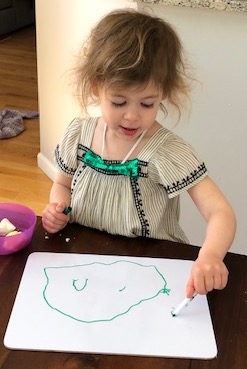
Finally, let’s get to some reassurance. Despite the craziness and exponential amounts of guilt I shouldered this week, clearly not being my best self, we made it to Friday. And our exhaustion and disorientation turned to pure silliness. My 7 year old’s class celebrated a Fancy Friday morning meeting and he wore a button-down shirt with not just a tie, but also a bow tie! (Listening in, I got to hear one classmate question whether leopard print is really fancy like her mom insisted.) One of the twins wanted to get in on the Fancy Friday action, so she wore a sparkly bow tie with her dress. She pretended to have “academic time,” and took out a white board and markers to write some “worms.” (Some misconceptions are just too delightful to correct.)


My 10 year old’s Friday math assignment was to use his own experience to write a word problem. This was what he came up with:


I shared this problem with my actual brother, who happens to be named Sam, who rightfully asked if he was being implicated in a murder. I can’t say for certain one way or the other.

The laughter that has overtaken us today reminds me of the importance of humor right now, just like this therapist noted in her piece entitled, The Toilet is the New Couch. And if sweetness is your jam and you haven’t already seen this amazing video making the rounds, check out this dad reading a bedtime story to his kids, supposedly in the future, about how the world changed for the better because of the virus. We can only hope!

Wednesday, May 6, 2020

Webinar on Early and Middle Level Education in Disruption

I recently had the incredible opportunity to moderate this UVM webinar featuring these amazing educators: 1st grade teacher Hannah Luce, early literacy expert Juliet Halladay, early and middle level grades expert Jessica DeMink-Carthew, and 7th/8th grade teacher Jeremy DeMink. They all had really valuable information, suggestions, and resources to share, so I’m making it into a blog post to highlight the key take-aways. One of the most interesting, and perhaps obvious in retrospect, things to me was that the advice and suggested supports for learners from early childhood through middle school are not very different. We all need the same things, just tailored to our developmental level. (I also found this webcast from the Society of Research in Child Development on The Science of Learning and Teaching at Home to be very informative and to cover many of the same points.)

Pandemic Learning: Coining a term for the current situation is difficult since this is unchartered territory. We tried to at least be realistic about what the current learning environment is so that we could then talk about supporting learning within that context. So what is pandemic learning? It’s remote learning in crisis. This emphasizes the even greater than normal need to attend to social and emotional wellbeing for you and your children (and for teachers!). And the remote part emphasizes that there are still teachers in charge of instruction, which helps to differentiate the parental role as a coach or manager, helping with motivation and encouragement, and schedules and time management.

Which brings us to Motivation and Independence: Authentic activities that children value and where children are set up for success are inherently motivating. While games or stories (books, shows, movies, etc.) might be obvious examples of activities that motivate children, they are not the only options. Giving children choice, including an appropriate amount of challenge to match their skills, and providing opportunities for collaboration are also motivating. In fact, making choices is addressing the need for autonomy and the development of independence as children move towards middle school. Providing menus of options; helping children break large tasks into smaller, manageable pieces; having them practice setting timelines; and providing frequent check ins with opportunities to reflect and celebrate successes will support this critical area of growth.

Doing this implies a certain amount of Schedule and Routine: We’ve been over this before, but routines are comforting to children because they’re predictable, and therefore support their emotional wellbeing. Another framing of routines is as norms that allow for sustainability (or more bluntly, sanity!). For example, upper elementary and middle school students might have a rule of “ask 3 before me,” where they must consult at least 3 people or other sources before turning to you for help. This means that you are not constantly needed throughout the day!

Similarly, schedules help children with the development of executive functioning skills by learning how to manage emotional and cognitive needs to achieve a goal (i.e., plan and prioritize tasks, initiate and maintain focus on tasks, and organize time to accomplish tasks). Noteworthy is that the creation of a schedule is tailored to the individual child through their choices, so it is not one-size-fits-all. You or they might notice which activities are preferred and which are not preferred and alternate them in their schedule. You or they might provide incentives or rewards for completing less favorable activities, like going outside to play or watching a show. Furthermore, schedules include more than just academics. As adults we try to plan when we’ll get in a jog or an exercise class, when we’ll prepare dinner, or when we’ll connect with a friend. Including things that bring us joy is critical, and again supports choice-making, independence, and executive functioning. We’ve talked about checklists as a way to create this type of schedule with kids, but having a morning planning meeting to do this together is another way. And, another key point is that supporting social and emotional wellbeing requires knowing when to take breaks, so the schedule must have some flexibility to stop when frustration levels are too high or to make changes when unproductive habits appear. As this article notes, focusing on social and emotional learning is a great way to get ahead of meltdowns by being proactive rather than simply reactive.

And in case it wasn’t clear from everything above this, putting Social and Emotional Learning and Wellbeing at the heart of everything pandemic-related was likely the biggest takeaway. Keeping our eyes on the big picture of having children come out of this experience physically and emotionally healthy is also in the interest of having them ready to learn and return to school as usual. For younger children, this means helping them to put words to the way they are feeling and to co-regulate those emotions by guiding them towards relaxing activities like walks, bike rides, games, puzzles, Legos, and so on. For anxious kids or those who struggle more with emotional regulation, they may need more than variation, they may need a cognitive distraction. For older children, who are developing their own identities and self-images, they need to maintain relationships with peers. Video chats for talking, sharing a meal, playing a shared game, or engaging around a shared interest allow for these connections and can remove awkwardness and pressure around interacting in this new environment. Social and emotional well being is not just for our children either! Teachers and parents also benefit from attending to their feelings, and we all benefit in terms of our attention, memory, and learning. Emotions matter for decision making, for relationships, for health, and for performance.

So what do we do when things are not working? Remember these guideposts:
  • Am I being realistic about what I can do in the context of pandemic learning?
  • Am I taking on too much responsibility for my child’s teaching and learning instead of allowing for motivation and independence or asking for the teacher’s help?
  • Are my child’s non-intellectual developmental needs being met (Maslow before Bloom)? Are our actions in keeping with the big picture goals?
  • Use your own Executive Function skills to reflect on what might need to be adjusted. Do we need to take a break? Trust your judgment, and return to things out of the moment by asking and listening, problem solving together, and encouraging self-advocacy but also recognizing when you need to advocate for your child.
Finally, we considered the potential Opportunities that might come out of this pandemic learning environment. First and foremost, hopefully a greater awareness and attention to social and emotional learning alongside academic learning will result. Hopefully we as parents will have a better understanding of our children in multiple ways, that allow us to support them emotionally and academically in a more personalized way. We will have more practice at interacting with school and teachers and supporting the school-home environment to allow learning to occur more naturally across borders and contexts. Perhaps our relationship with technology will be more balanced after prolonged overuse and over-reliance. Maybe our knowledge of where to go to find high quality and effective digital resources will be enhanced.

And we ended on the reassuring note that all kids will have experienced this unusual disruption when school resumes and that teachers are quite used to and capable of handling kids with wide ranges of abilities entering their classrooms. And when all else fails, turn to humor! Some of these are hilarious!

Monday, May 4, 2020

Unplugging

Last week was our district’s “spring break.” At first I wished we could continue in our school-from-home routine, but soon I realized how nice it was to actually have this break from managing devices, troubleshooting technology, figuring out who is using which device when, with which headphones, in what location, etc. Unplugging used to mean getting away from screens, but now it has an even bigger meaning. It also means unplugging from the many new roles I’ve been thrown into since school (buildings) closed.

And the result was that, for the first time since quarantine started, I actually felt that pause button of which I’ve heard and of which I’ve dreamed. I actually forgot which day of the week it was. I didn’t worry about time. We went out for a walk and we came home and we ate. We spent time together in the way I thought we might all along. We played games, bickered, went for walks and bike rides, bickered, read, cooked, bickered some more, cleaned the house--oh wait, no, cleaning didn’t actually happen. I finally was able to actually slow down. (Who knew it would be so hard to slow down, even when thrust inside your own home?)

And then I noticed it again this past weekend. When there aren’t all these plans and options for things to be doing, there is no maximizing--no making the “best” plan, trying to figure out the “ideal” timing to fit things in, no trying to compromise and give everyone a choice and make and keep everyone happy. Instead, we went outside. We scooted around the block. We drew with chalk on the driveway. We chatted with our neighbors across the street. We noticed the space beside our house that might just be a great place for a fort or castle (depending on your preference). We were creative and playful and interacted because our minds were open and our bodies were present. (As you’ll note from this mind-body talk, I still haven’t failed my imagined self on the meditation front--woohoo!)

Never would I ever have thought to gather sticks and make a fortress (there we go--I combined fort and castle) before, but we did. And I can’t put my finger on why this happened. There are still plenty of things I could do.

Maybe it’s the fact of the quarantine continuing for so long that has gotten me here. We’ve all read about how unsustainable the situation is. This article found that the workday has increased by an average of 3 hours per day! The lamenting about the inability to unplug from work had me thinking about how, in addition to the demands of working at home and supporting learning at home (each of which are full-time on their own), we are also now parenting 24/7. We used to have other people in our children’s lives that would play with them, learn with them, co-regulate their emotions with them, or take them when we needed a break. And while adults might be able to get these things more naturally in a virtual world, we still suffer these same losses to our freedom to do these things in our own way and on our own time. Maybe there is only so long we can stay in these negative states of panic, fear, loss, anger, and so on, and then we must somehow find a way to unplug, and that for me unplugging meant stepping away from the constant multi-tasking and managing of people, logistics, and technology. And that when I unplugged in this way, I made space for being in the moment. Maybe.

Or maybe it was just luck and it too will pass. Whatever it is though, we are all doing a lot of “never would I ever”ing. And in that spirit, I leave you with this funny podcast about the joys and struggles of motherhood, and this admittedly long episode about the things we never thought we’d find ourselves doing or allowing. And if you have a chance to unplug from everything else, it is full of relatable moments that might make you laugh, reflect, and feel seen and validated, and maybe that’s just what you need right now.

Friday, May 1, 2020

Continuing… Is a Pandemic Really the Time?

You may recall this part of my post about Finding the Humor in Failure:

“Treading the line between parent and teacher can often be a challenge…Snap out of it! This is not the opportunity of this pandemic. Quality time and fun and organic learning is the opportunity.”

As promised, I have more to say about this! For starters, it’s not so easy to “Snap out of it!” is it? We have all sorts of reasons for why we might be pushing our kids. Perhaps we’re worried that our kids will fall behind, or we’re worried about letting bad habits form or we’re catastrophizing that these bad habits could (gasp!) solidify. Maybe it feels like supporting academic learning is the only thing in our control right now, or maybe we just have a lot of practice at expecting more of ourselves so it’s easy to do this to others, particularly in times of stress. Or maybe it feels like we’re the ones failing when our kids do work under our supposed supervision that doesn’t match what we feel are their capabilities.

Whatever the reason for pushing, the fact remains that running head first into a defensive line doesn’t typically make much forward progress. (That’s as close to a football analogy as I will ever get, so enjoy it!) Are these actually bad habits? Are our kids being lazy, or are they actually communicating preferences or just expressing what they need right now? And to be honest, how much of our children’s choices are under our control? Yes, we can guide and suggest, but we aren’t the ones doing or deciding for them. We can support and encourage, and be there when they regret a choice. But actually letting them make choices and live out the consequences, for better or for worse, out there in the real world is the only way they can learn about the kinds of choices they want to make. And loving them and being by their side, no matter what, may actually be our strongest lever of change.

Speaking of which, I had a real aha moment with that lever the other day. It was the first day back from “spring break.” My oldest was anxious about getting back into our school from home routine. He was anxious about what work might be awaiting him and how he'd get through it. So we sat down and looked at his weekly menu from his teacher, organized by assignments to turn in, suggestions for additional work, and bonus ideas to extend learning. We made a checklist for the day that included getting started on two assignments, checking his school email, and a suggested activity of using Flipgrid to share two truths and a lie with his class (and then watch his friends’ posts and respond with his guess of their lie). We also included our everyday activities: opportunities for movement, music, independent reading, video chatting with a friend, household help, collaborative learning time, free choice, and independent time.

Despite putting suggested times next to each line of the schedule, he went down the rabbit hole of Flipgrid. (This is his first social-media type experience, so it’s not surprising that he was roped into the commentary, but it is a good reminder that this kind of resource, regardless of the potential for creativity and connection, requires some scaffolding for learners to manage their time. More to come on things like this and Messenger Kids in a future post...) At the end of the day, one of the assignments was not started, and he felt stressed about it. Normally this would mean that I also felt stressed about it. Lucky for all of us, today was not “normally.” Remembering my lever, I reminded him that I’m here to support him in organizing his time and finding strategies to stick to the schedule, but that it’s up to him to decide what’s important to him and to prioritize his assignments. Miraculously, the next day he asked me to set a timer for 15 minutes when he used Flipgrid, and he worked his way down his checklist with more success. (Phew! Glad that didn’t backfire!)

Now I don’t mean to suggest that school assignments aren’t important or that you should say something that you aren’t comfortable following through with yourself. What I do mean to suggest is that you (and I) are not the student, nor are you (or I) the teacher. Your child is the student and it’s up to his or her teacher to motivate and give feedback when an assignment is not completed or is not completed in the way that meets expectations. For the same reasons some of us cannot teach our own children to swim or ski but do love to swim or ski with them, some of us cannot be their teachers and expect to be able to actually enjoy learning time together. Separating those roles and responsibilities may actually be the path towards fun and engaging time together that has learning within it.

I also don’t mean to minimize the individuality of your child and situation. For me, I knew that my oldest was motivated to complete his assignments and capable of doing so, and that his anxiety could be its own gentle lever to work on time management. For others, motivation is the struggle or working through social and emotional needs takes priority over academic ones. I have a lot more to say about both of those things, so stay tuned for that post next week!

And lest you think this revelation changed my world… today I found that same child curled up at the bottom of a closet during a Zoom meeting with his word study group. Who moved my lever?

Balancing In-Person and Remote Learning: The Hybrid Model

Most conversations about reopening schools include the hybrid model. This mix of in-person and remote instruction can have many varieties, i...