Tuesday, April 21, 2020

Connecting through Media

Contributing Author: Savitha Moorthy, Executive Director of Tandem Partners in Early Learning, and also a fellow parent trying her best to keep it together like the rest of us!
When my son Avi was about 18 months old, one of his favorite tricks was to reach into my pocket while roaring like a tiger. This was his way of asking me to play Daniel Tiger videos on my phone. Like many modern parents, my husband and I have worried from time to time about how we can navigate the tricky territory of media use with a young child--and in our current reality, these concerns have reared their heads again.

Doing away with screens is simply unrealistic even in normal times but it is especially the case at the moment. Also, it just feels like a double standard in a home where the two adults use their laptops and mobile phones for a substantial amount of the day. I don’t claim to have found any answers, but over the last few weeks, my family is evolving towards something that’s working for us: an imperfect mix of media use, conversation, storytelling, and, admittedly, a little electronic babysitting that helps us all hang on to our sanity.

1. We focus on the good stuff.

There’s a reason why Daniel Tiger was one of Avi’s first show. Relatable experiences, characters that model positive traits, and the potential to stimulate comments and questions are the hallmarks of the media we love. When we watch Daniel Visits the Doctor, we compare Daniel’s experience with Avi’s own pediatric appointments. It’s because of Dinosaur Train, Avi has learned to say, “I have a hypothesis,” and now he even knows what that means. From Puffin Rock and Tumble Leaf, he has learned how to channel his curiosity and explore things in the world around him.

2. Screen time sparks conversation.

My husband and I often join Avi when he’s watching a show or playing with an app. We ask him questions about things we’re watching and doing, point out things that are interesting to us, and relate the things in the show or the app to our real life. While this type of interaction is ideal, engaging in it is a luxury. If we’re busy when Avi is watching a video or playing with an app, as is often the case, we try to talk with him about the show afterward, at dinner or bath time, or sometimes even when we are out for a walk. He tells us what he thinks, and while it’s not always coherent, it sure is fun to listen.

3. We connect media with off-screen play and storytelling.

Sometimes the media content leaks off the screen into our life, into our play and storytelling. I have the Peep Family Science app on my phone, and watching the videos and animated stories about ramps has led to hours of fun as we experimented with how objects moved down ramps, developed a language for talking about it (some things roll while other things slide), and, with the help of some corrugated cardboard and a staircase, fashioned some ramps of our own.

4. Screens help us stay in touch with the people we love.

Our childcare provider offers a half hour of virtual programming every day of the week. There’s a song, a book, a craft activity and before you know it, we’re all saying goodbye. A video call with a bunch of four-year-olds is exactly as dysfunctional as you imagine it’s going to be. Children wander on- and off-screen, parents struggle to keep up with the transitions, and the conversation is rich in non-sequiturs. But it is the best thirty minutes of our day: the virtual school gives our family one little anchor around which we structure our daily routine and the opportunity for Avi to connect with his teachers and his friends is priceless.

Our system is far from perfect.

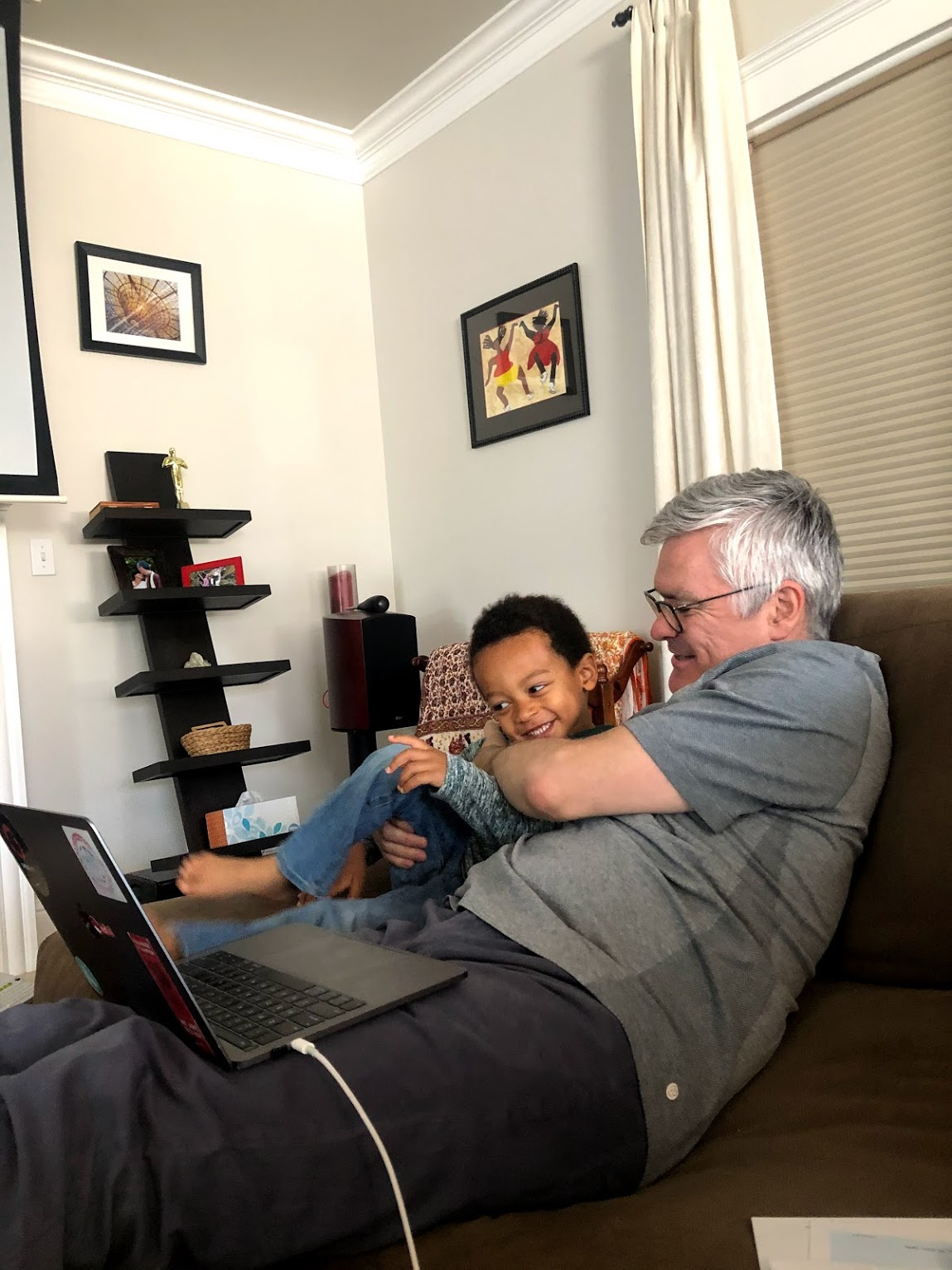
Like all families, we have breakdowns from time to time, and we struggle with them. It is often companionable to sit on the couch together, doing parallel play with our respective media—but Avi is usually not ready to stop when we are ready for him to, and this story always ends in tears.

Although we are pretty relaxed about screen time at home, especially now, we do have some clear boundaries. The television comes on only when we’re intentionally watching something. There are no screens while we’re eating or before bed time. We prioritize spending time outdoors over staying home. We’re lucky to live in a place where going outside is an option almost all year round, but even when it isn’t, we try to find something to do where we can move our bodies. I’ve learned the hard way that burning energy is key to a successful afternoon nap, and it keeps us (adults and children) away from the temptation of screens.


Monday, April 20, 2020

School at Home

Recently I was lucky enough to be interviewed by our local news station about how to support learning at home during this pandemic. For those who missed me, here is the segment!

I was really proud of how it came out, but I had about 10 minutes worth of stuff I wanted to share and only about 10 seconds to convey it in. Lucky for you, here are my more detailed thoughts:

It’s not Homeschooling

I was really glad this point came through. There are still teachers reaching out with specific resources and assignments, and doing their best to support learning from a distance. Parents across the country and world did not have a sudden philosophical shift--the vast majority of us plan to send our kids back to school literally the second they reopen! And true homeschooling uses the community’s resources to support learning in a way that is also impossible now. But we can take some of the principles of homeschooling and apply them to the current situation by remembering not to try to teach and support our children in isolation, and to connect with people, experiences, and resources virtually.

Silver Lining

We have the opportunity to individualize and highlight the learning in our own interests and hobbies and that of our children, generating excitement, creativity, and energy for learning. Differentiated learning is incredibly difficult in a full classroom, and now learning can truly be at the level of your child. And skills and dispositions towards learning that are also incredibly difficult to foster at school are perfect for learning at home through projects, pursuing curiosity, and playing with siblings or family members that know more or less about a topic or have more or less experience with a skill. All of these are incredible gifts we can give our children to be lifelong learners, and that will help them when they return to school.

Screen Time: Quality over Quantity

Even before the pandemic, experts and researchers were differentiating between the content of media, contexts in which it was being viewed, played, or used, and the quantity of time spent with devices and screens. Using digital resources to learn, to collaborate, to connect, to move, and to spark interest and creativity is very different than using digital resources to relax and find general entertainment. Still, media is also designed for vegging out, and can and should be used for that, especially in times like we’re currently experiencing. However, as much as possible, watch or play together, talk about what you’re watching or playing, and make connections from the digital world to the real world.

(As a side note, Vermont PBS now has daily curriculum and programming by age group! And this spreadsheet of livestreams has a great calendar/schedule organized by topics and ages!)

Sifting through the Deluge of Resources

We are all being inundated with suggested resources to use with our kids. It’s truly overwhelming, even for those of us trained in evaluating these resources. Sometimes being overwhelmed by choice can actually paralyze us. Perhaps paradoxically, fewer choices is always better than too many choices. I remember feeling this way about pregnancy and parenting books, and my husband and I decided we would pick one or two books that we connected with and then ignore all the other options. (For the record, we are What to Expect and 1, 2, 3 Magic people.) It really allowed us to actually read and understand what those books had to say rather than gleaning a bit from a wide range of things, never truly getting an in-depth understanding of development or specific parenting strategies. It’s the same with all these resources we’re being sent right now. When you find one or two that speak to you and your family, stick with those. You’ll get more into them and get more out of them. Learn with them. Expand on the stories or ideas within them. Continue with those characters off the screen. Talk about the ideas on a walk. Less is truly more in this instance.

Connection

Digitally or not, we should focus on interaction and collaboration. I’ve said it repeatedly and will say it again: learning is inherently social! Kids are really missing their teachers and their friends, their routines and their activities--their normal! Even though connecting with those things is different now, it is still possible through video chats, telephone calls, letter writing, livestreams or recorded videos. Keeping the local connection (i.e., videos from actual teachers, instructors, coaches, and librarians that they know and recognize) helps with this different way of connecting feeling as normal as possible. And our relatives are now also at home and have time to talk and interact from their side of the screen, so utilize them!

Routine and Structure

Kids thrive on routines and predictability, and for some, school was the only place they were receiving this. I won’t say more here, but you can refer back to our prior posts on our routines!

The Importance of Choice and Agency

Keeping a schedule does not take away choice and flexibility, which are key ingredients of successful learning environments. Kids can select the order and pace of what they do, select what they will do to check off a category in their schedule, or make suggestions for what could go in a schedule. For example, movement/outdoor time allows them to decide if they will go for a walk, play catch, do a yoga video, have a dance party, or something else. They can decide they need a half hour of movement time before and after they do a learning activity, and structure their schedule accordingly. They could even coordinate with a sibling and plan an independent activity while the other is participating in a class meeting. Speaking of which, make sure to include some free choice and independent time in the schedule to give them practice at following their interests and managing (a limited number of) choices, and giving them a chance to have a break from the people surrounding them non-stop. This practice will help avoid the question, “What can I do?” and keep kids motivated and engaged. And flexibility is so important because spontaneity is exciting, and because sometimes you need to seize the moment and go for a hike or watch a family movie.


Attention Spans

Preschoolers can focus for about 10 minutes, early elementary students for about 15-20, and upper elementary students for about 25-30. Not only do we need to keep this in mind when we consider how we chunk our time for learning, but we should also consider it as we think about the total learning time for the day. By separating out the learning time from all the other valuable purposes of school (if you’re really interested, here’s a longer version of this point), kids don’t need a full school day to get through their learning. That’s what leaves time for unexpected learning, playing, relaxing, cooking, virtual playdates, and household chores (ha!)! And that also means that supporting your child’s learning for 1-2 hours each day is plenty. The other times can be learning through activities, games, movement, or other things on their own or with a sibling or with a virtual partner.

Treat Yourself with Kindness

In case you haven’t noticed, this gig is really, really hard! Remember to be kind to yourself, notice your feelings and those of your children, accept that they are normal, and treat yourself with breaks and rewards! Our basic tendencies, for better or for worse, are being unveiled right now. Our typical ways of coping and of being have been ripped out from under us (not to mention our families being at work with us!), plus the necessity for these strategies has increased tremendously. I cannot emphasize enough how challenging that is, but perhaps I don’t need to since we are all in it! And we are in it together!

Thursday, April 16, 2020

Finding the Humor in Failure

We write a lot about what we’re doing and ideas for how to promote and extend learning with our children. We often forget to point out the spectacular failures that occur each and every day (and are an inevitable part of all of this!) alongside these successes. In an effort at being transparent, this post opens the doors on our imperfections. And we approach it with humor (like this amazingly funny article on how to stop all that fighting!), so that we don’t just cry and have a pity party.

1. Chalk Stations

On a recent walk we came across a path with stations described in chalk at regular intervals. For example, do 20 jumping jacks or jog to the next station or hop like a bunny to the next station. There were even messages along the way like, “Give someone a compliment!” I thought this was a great idea, and given that we have a block that is a half mile around, I set out with all 4 kids, 3 scooters, and chalk to do the same right in our own neighborhood. Here’s what I didn’t count on:
  • One of the twins took a solid face-first spill over a small crack in the pavement. There was lots of blood flowing from her lip and chin. And there were lots of tears. I had one tissue in my pocket. 
  • It takes a lot more chalk than I realized to write big letters, so my fingers are scraped up from using the last bits of chalk. More blood. Same one tissue.
  • Half a mile is a lot longer than you think when you’re trying to come up with stations every driveway or so. If you find our stations, you can probably guess where we started and where we ended. You have to hop on one foot for a lot farther than you would like I’m guessing. And you probably would have been happy walking on your tippy toes or doing a silly dance for a while longer.
  • “Spit to the next tree” is supposed to be “Sprint to the next tree.” Apologies in advance.
  • Planks and pushups aren’t that comfortable on concrete, but one of our kids insisted.
  • I didn’t bring snacks on this epic journey. It took us an hour to get around the block and complete this activity, which in the world of toddlers is similar to the time between breakfast and dinner. And apparently pockets full of acorns, leaves, and pine cones don’t substitute for human food.
On the bright side, I’ve seen some of our neighbors using the station ideas as they go by all day, so it was all worth it! And, when the boys need to move, I can send them out to do a round of stations and they are still enjoying it!


2. Is a Pandemic Really the Time?

Treading the line between parent and teacher can often be a challenge, particularly as someone who typically struggles with things being “enough.” In talking to a friend about whether to push my son to dig deeper into an assignment, trying to slow him down and stop the rushing to get to something else, she so kindly noted, “I’m not sure a pandemic is the right time for that.” This immediately cracked me up too, because it is kind of ridiculous to think that this was the time for that. Snap out of it! This is not the opportunity of this pandemic. Quality time and fun and organic learning is the opportunity. (Note that we have a lot more to say about this, so stay tuned...)

3. General Losing Our Sh**

I seriously hope that this blog has not given anyone the impression that we have it all together. We don’t. We are trying our best, just like you are. Some days go well, some days are great, some days are a mess, some days I’d do over, some days I’d just erase. And really I shouldn’t even be talking about days. We have minutes or hours that are wonderful, and we have minutes and hours that are terrible. And they can coexist or happen side by side. Try to remember something good that happened or that you learned or that you will do next time. Remember that the Rose, Thorn, and Bud all exist together. And perhaps it’s good to remember that it’s not just children who are regressing now, and that’s normal too. Guess that wasn’t really funny. Sorry about that.

4. Asking for Help

I’ve jumped on the Brene Brown bandwagon, so I’ll leave you with this quote from her book Rising Strong about how we all need each other:

“In The Gifts of Imperfection (excerpt and talk), I define connection as ‘the energy that exists between people when they feel seen, heard, and valued; when they can give and receive without judgment; and when they derive sustenance and strength from the relationship.’ Connection doesn’t exist without giving and receiving. We need to give and we need to need. This is true at work and at home.

In a culture of scarcity and perfectionism, asking for help can be shaming if we’re not raised to understand how seeking help is human and foundational to connection. We can encourage our children to ask for help; however, if they don’t see us reaching out for support and modeling that behavior, they will instead attach value to never needing help. We also send strong messages to the people around us, including our children, friends, and employees, when they ask for help, and in return, we treat them differently--as if they are now less reliable, competent, or productive. The bottom line is that we need each other.”

And since this post was supposed to be funny, here are a few parting jokes (and a place to find more second grade-ish humor):

Question: Why did the pineapple take off his pants? Answer: I don’t know! I wasn’t there!

Question: Why didn’t the skeleton go to the dance? Answer: Because he had no body to go with.

Question: What did the janitor say when he jumped out of the closet? Answer: Supplies!

And for those of us who live in a world of Zoom these days, check out this Zoom parody!

Wednesday, April 15, 2020

Playing and Then Making: Top Trumps

For a few months now my kids, especially my kindergartener, have been hooked on a card game called Top Trumps. In line with the “learning is inherently social” theme of the week, we play in pairs and as a family, and enjoy it as a way to spend time together AND hopefully hit on some math concepts and strategies along the way. There are a gazillion different Top Trumps decks, but here’s a typical card from one:


Each Top Trumps deck has a theme (in this case, Minions: Despicable Me 3) with a list of theme-specific categories that are listed on each card (here, they’re Courage, Goofiness, Knowledge, Fun, and Top Trumps Rating). Within each deck, cards differ in the number assigned to each of those categories.

To play, each person starts with the same number of cards. The youngest player starts the game, and then the winner of the last round starts each subsequent round. This player looks at the top card in their pile and chooses which category is in play (so here, they might say “Knowledge: 35”). Players reveal the card at the top of their pile, and the one with the highest number in the chosen category wins everyone’s card for that round. The game continues until one player collects all of the cards in the deck.

A great thing about this game is that it teaches the idea of a distribution; in this Minions deck, for example, an 8 is a high Courage rating, but 16 is not a high Goofiness rating. Over time, you learn which category to favor for particular cards, and during a particular game it’s useful to remember who has the top card for particular categories (and when that card is coming up). The more you play with a single deck, the better you get, which proved to be great for my kindergartener who has mastered several decks.

Our first deck was the Despicable Me 3 deck, which forever will have nostalgic value because we played it endlessly on our pre-COVID vacation. I think we can each recite the numbers on each card in our sleep. Since then, winning purchases have included two Harry Potter decks and a Guinness World Records deck (warning: the Most Weight Lifted by Nipples card is really hard to look at). We also got a Wonders of the World deck, which the kids declared was boring/too schooly almost right away-- FAIL!

A fun extension of this is that they each created their own Top Trumps deck. C initiated this (but his deck is still in the works), and E watched closely before quickly following suit. Their decks are totally playable AND will serve as great reminders of their current interests/obsessions. For C, it’s all about the Red Sox and for E, it’s all about Pokemon (his second deck features Sonic the Hedgehog):


I like that for C it has required some thought, baseball card sorting, and internet searching to get good distributions for things like batting average, home runs, RBIs, etc., while also giving his favorite players an edge. I’d say the modification experience has been thumbs up all around, except that I find the f***ing cards everywhere I turn...and I mean everywhere!

Tuesday, April 14, 2020

Board Games

We’re sure you’ve noticed by now that we’re often describing play-based, or interest-driven, learning in this blog. Taking the time to observe and play with your kids can show you how they are constantly learning. Having a way to label or notice the specific aspects of learning within that play can not only be satisfying to you as an adult, but it can help you to highlight and amplify it for kids and solidify their learning. (This article talks about these opportunities for noticing, highlighting, and amplifying math learning, and references some great work by our colleagues too!)

Games can support social and emotional learning skills. Two of our colleagues recently wrote an article noting the benefits of games in developing and practicing problem-solving skills, perseverance, and growth mindset. Just remember that a game is still primarily a game, and don’t dwell on the learning over the fun.

Recently we broke out Monopoly in our house. I figured a longer game isn’t as impossible these days. There is adding and subtracting money, there is doubling rent for monopolies, there is strategy (and a lot of luck!), and there’s teamwork and collaboration in making deals and trades. And the fact that the game takes a while also means it requires planning ahead, sticking with it even when things aren’t going your way, considering changes to strategy when unexpected things happen, and so on. When you notice these areas of learning (and can maintain patience), letting the child be the banker, or not immediately telling them how much change they should receive, allows them to practice their mental calculations. Describing your thought process out loud about how you are deciding whether a deal is fair or not (Would I do it in reverse? How much is what I’m offering worth and how much is what they are offering worth? What will it mean for the game if I make this trade? If I make this trade, what leverage does it give me or the other person for a subsequent trade? What is more valuable to me right now in the game, money or property?) models these planning and problem-solving skills.


I came across this list of 20 board games by age that might remind you of some of your favorites that you haven’t considered playing in a while. Break it out, and remember, you’re learning, so just relax and have fun!

Since this week we’re focusing on collaborative learning, keep in mind games where players must work together to win, like Richard Scarry's Busytown or Peaceable Kingdom games like Hoot Owl Hoot or Seeds for the Birds or Cauldron Quest.

And stay tuned for using games as your launching pad for even more collaborative learning!

Monday, April 13, 2020

Collaborative Learning

Learning is inherently social. We learn with and from each other: by figuring out how to explain something; by listening and understanding; by sharing in a new experience; by learning alongside someone who has more practice; by watching a more expert peer succeed at a challenging task. Hearing something someone says or does might spark an idea or a question that leads us to learning something unexpected. Listening to a podcast or watching a show may cast an idea in a new light. There are so many ways that we learn together! In that spirit, Marion and I are collaborating this week, writing some joint blog posts and inviting others to share their thinking as well.

So what are some ways to do collaborative learning at home? While siblings make some of this more intuitive, it can also make things more difficult (remember the War of the Roses scene Marion described here?), so don’t let that be a roadblock. Our family has devoted an hour in the afternoon to what we’re calling “Collaborative Learning/Explore Time.” We’ve agreed that it can be playing a game or doing a puzzle together, learning something together, or creating something together, but it can also be something to share with someone else. Writing letters or drawing pictures for others fits this category, as does designing something with someone else in mind, like creating your own lesson (a surprising hit and a surprising realization that this is hard and takes some trial and error, followed by refinement, and then re-testing). Or like Marion mentioned in her Making Media blog post, creating and performing tricks or skits, or making an exercise video! (By the way, this exercise video was a huge hit with all of my kids because seeing other kids as teachers is really exciting, made them feel like they can do it, and inspired them to do something similar!)
Collaborative learning can happen spontaneously and unexpectedly too! Today we got some new ping pong balls. When opening the package, one fell out and amazingly provided a half an hour of learning and exploring disguised as playing. Our twins watched where the ball would bounce or roll, following it around and giggling the whole time. Then they tried to roll the ball to specific places. There were lots of misses of the desired target, lots of moving of the target to try and catch the ball, and more giggles. What they didn’t realize, of course, was that they were learning about trajectories, friction, ramps and motion, about experimentation and asking questions, and about trial and error. And not realizing any of that is really the beauty of it all!

Finally, remember your non-quarantine village and reach out virtually to support collaborative learning! What skills, crafts, or other ways do friends or relatives have to play or learn virtually with your child? Heck, what can someone else do on the other side of the screen to entertain your child? My dad is giving my oldest son Hebrew lessons via Zoom, my friend’s mother-in-law is reading books to her son during their family quiet time, my brother’s kids performed a virtual concert on the piano and cello for our family, my boys often have video chats or virtual playdates with friends where they share new magic tricks or jokes they’ve learned. While my kids have not yet had interest, I’ve been excited about the potential of writing up interview questions and interviewing friends or families and then writing up news-like stories for a family newspaper or magazine. Or creating their own game. Or creating a scavenger hunt. Or starting a garden. Or using Peppa Pig as the inspiration behind a family skit.

As we think about supporting our children at home, this creative time to learn with and from others in new and different ways seems like a real opportunity. Keeping learning fun and interest-driven will not only help kids over their boredom hump, but it may actually lead to their learning in new ways without them even realizing it (a la ping pong chase)!

Friday, April 10, 2020

Caps for Sale

Most of us know the classic book Caps For Sale by Esphyr Slobodkina, but in case you need a refresher… A peddler carries all his hats on his head, neatly stacked and organized by color, trying to sell them. As the day rolls on, he finds his way to the shade of a tree to rest, being careful not to disturb his hats. As he naps, some monkeys snatch up his hats and then sit with them in the tree above him. When he awakes, he tries to cajole the monkeys into giving him his hats back with some finger shaking and hand wringing and foot stomping, but the monkeys just “tsz” him, and his anger grows until he throws his only hat on the ground. To his surprise, the monkeys copy him and begin to throw their hats to the ground! The book ends with the peddler reorganizing his caps by color, placing them on his head, and returning to his regular business of selling caps.

At first I was surprised to find myself thinking about this book on a recent walk I was taking. But then I realized how apt a metaphor that book is for our current situation. We are all wearing many hats right now, and there are oh so many monkeys out there messing with them. And the more we meet those monkeys with anger and frustration, the more we will have it mirrored right back at us. But connecting with those monkeys will let us sort through our hats, reorganize them, and keep on walking. Here’s what I mean:

Wearing Many Hats

Right now we are wearing all those hats--parent, partner, teacher, house cleaner, master organizer, manager of technology, professional, referee, and plain own self! We definitely wish we could sell some of those hats. Heck, “50 cents a hat” is sounding pretty darn good right about now! Not only are we wearing all of those hats, but the roles that they represent have morphed and changed at an alarmingly rapid rate. What it means to be a parent right now is quite different than when we had options for breaks from our children, when we weren’t responsible for supporting their learning at home, when they could play sports or be physically with their friends, when we weren’t worried about ourselves or others getting sick, etc. And being a parent of children who are at different stages of learning, development, and emotion means that it’s really not a single hat. Keeping those new, multiplied, stretched out hats balanced on our heads has become precarious. How can we organize them and make them neat again?

As always, I don’t really know how we organize those hats to balance them nicely on our heads. But as someone who has always preferred neat and tidy to messy, here is what I’m learning right now. Shifting between hats is really challenging! Recognizing which hat I’m currently wearing and which hat is being asked for is definitely helpful in meeting the need coming at me. And recognizing that it can take time to switch hats is also important. Give yourself a minute, or a breath, and then orient yourself to what new thing is in front of you. Also, if you can avoid shifting repeatedly and rapidly, that seems ideal. For me this means that I have 2 hours in the morning where I’m mom to 4 kids and we eat and play and try to get outside. Then I have an hour and a half with my older 2 kids where I am mom and teacher supporting their learning. Then I have 4 hours where I put on that professional hat. Then back to mom… So I have transitions between my roles, but I have chunks of time where I’m wearing just one or a couple of those hats. (I know many of you don’t have the same options for structuring your time, but hopefully there are still chances to chunk your times in ways that help minimize role transitions.)

Monkey Business

Okay, reality check: There are multiple interruptions to the time engrossed in a particular role. At any moment, I can become a referee, technology manager, or house cleaner (how did yogurt end up there?!). We are going to stumble when our caps are removed, switched, and out of order, and the messiness that was hidden in that neat stack is bound to be revealed. I guess we just embrace the honesty of that, and try to feel okay about it.

Then there’s the fact that there is an abundance of uncertainty about how long we will be in our current situation, what further changes in routines or schedule we will need to navigate, and the resulting emotions that are a part of all of that. Since there are 7 of us living in our house, there are a lot of cycles through emotions, and the cycles have higher peaks, lower valleys, and are more condensed. But when I think of all that is being thrown at me as “monkey business,” it can feel just a little bit lighter and I can feel a little bit better. Maybe it will for you too.

Throw Down Your Hat

It seems that at some point each day there is a moment of acceptance (or perhaps it looks like resignation, but I think it might have a kernel of acceptance buried under it). “Okay, we’re really doing this for another day.” And miraculously, when that moment arrives is when we each typically rise to the occasion. When we were fighting against those monkeys, they were fighting right back. But when we realized that those monkeys just want to play with us, we can look up and gain a new perspective. We can begin to pick up and organize those hats and keep on walking. And lo and behold, when we pick up our hats and keep on walking along, our children tend to follow.

The closest picture I could find to multiple hats!

Balancing In-Person and Remote Learning: The Hybrid Model

Most conversations about reopening schools include the hybrid model. This mix of in-person and remote instruction can have many varieties, i...