Tuesday, June 2, 2020

Different Stages of Grief

I wrote a post last week about the loss of normalcy during the pandemic and the potential for growth. And then the White world awakened to the reality of racial injustice, deciding there was no more time to sit on the sidelines and wait for change, and that everyone was a part of the solution. The post I was planning seemed tone deaf, and a new one seemed needed. While I cannot profess to have something insightful or even helpful to say, it does seem that we each ought to at least reckon with our feelings, our beliefs, our actions and begin to step into the arena to be a part of the solution. This is my step. It is a baby one, but a step nonetheless.

I grew up going to a Jewish day school from kindergarten through sixth grade. For seven years, I heard from Holocaust survivors who shared their first hand accounts of the fear and struggle, sadness and anger, and ultimate humanity and survival. It was simultaneously terrifying, inspiring, and confusing. Perhaps that’s why I had a need to know more. I was not a bookworm as a kid, yet I sought out books set during the Holocaust or that contained accounts from children. I had frequent nightmares of being chased by Nazis. I’d awaken and go through scenarios of how I’d play dead, how I’d run, where I’d hide, how I’d outmaneuver. And I imagined living in a ghetto, being torn from my family, marching unknowingly into gas chambers, surviving death camps. As I write this, it sounds morbid. Maybe that’s why I’ve carried forward a seemingly large sense of the sadness for those left behind. But it was the way I knew to take control of all that horrible information. I can’t even imagine what it’s like for Black children to be hearing today’s stories and living them, rather than hearing about it in the past tense and relegating the fear to the world of dreams.

Each survivor story I ever heard always had a tone of hope, that sharing their story and educating the children of the future would ensure that all they endured would be put to good use. I fear that I’ve lost sight of some of that. I’ve felt invincible, even as antisemitism has risen in the world around me. I feel safe in my bubble, and would rather not think about or imagine the scariness that exists beyond my immediate environment. I can barely even read or watch the news, let alone let it sink in. And that makes me feel so guilty because that is such a luxury.

I cannot begin to understand the experience of being Black in America. But I hear and see the injustice, I fear and feel for those affected, and I vow to work to understand and to not pretend to be invincible myself so that I can stand with those who know they can never be invisible or invincible.

A lot of our posts on this blog have to do with leading by example, supporting each other, and finding opportunities amidst challenges. I have believed that everyone has their own worries, struggles and successes, and that my own are not diminished because there are those whose worries and struggles seem so much deeper and daunting or whose successes so much harder earned. I recognize my experience is my own, but I still think there is a lot that is relatable and supportive of others’ experiences. In the area of racial injustice, I feel lost. My current worries, struggles, and successes do seem diminished in the context of what others find themselves up against. But I think it’s important that this comparative suffering doesn’t keep me silent for fear of further insensitivity. I may not know the best thing (or even the better thing) to say yet, but in speaking, I can have the chance to listen and I can learn. With this in mind, it is heartening to see the impact of this injustice being felt worldwide and the voices being lifted from all corners of the globe. This is not just a local issue, and not just a national issue but a global one. And it’s largeness feels entirely overwhelming.

I guess this is where those stages of grief from my original post may provide some helpful landmarks. Many of us find ourselves in the lands of denial, anger, bargaining, depression, and even acceptance. These are important guideposts on the journey to recognizing, labeling, understanding, and acting against racial injustice. But I believe it is the need for meaning that has the greatest potential for change.

In my own meaning-making, which is in its infancy, I find myself thinking about diversifying our children’s and our adult bookshelves with stories that represent wider perspectives, backgrounds, and contexts. We have made some efforts in this area with regard to LGBTQ literature and are proud when our kids are quick to notice that the school’s puberty video only references feelings around male-female relationships. But I’m ashamed to notice that we have merely two picture books with primarily Black characters and not many more books about the Black American experience. What about our dolls? Game pieces? Art on our walls? No wonder we don’t have many conversations around race. What would spark it?

As I continue to think about my next steps, in terms of conversations within my own family and community, I will definitely be digging deeper into online resources and tools that are geared towards supporting these conversations and deepening understanding of the experiences of others in our world. But for now, here is a starting list:

From Common Sense Media:
Trevor Noah’s heartfelt and clearly explained thoughts about the current state of society

Embracerace has great resources and articles for families

Teaching Tolerance also has great resources for educators

Wednesday, May 27, 2020

The Bumpy Ride

Another day, another metaphor. Well, a literal one this time. We went on a family bike ride, just the six of us. It was a bumpy ride.
We’ve been encouraging our now 8-year old to learn to ride a 2-wheeler for a while now. He was never into his balance bike and has been an avid scooter-er for years now. The bike had grown into a larger-than-life thing. So we stopped pushing. Our school district does a unit on biking in fourth grade, so at the latest, we hoped they might teach him. And then COVID hit, and a great way to be socially distant while with your friends is to go biking. Motivation kicked in, along with the idea of using his big brother’s bike with hand brakes and the pandemic-inspired stretched out time and space to practice something challenging. Suddenly it clicked and he could ride!

Oh the joy! He rode all day long. He told everyone he saw. He was beaming with pride. And then snap--the chain broke! This is probably not a big deal for bikers, but we are not handy with anything, including bikes. “Not to worry,” said the problem-solving side of my brain, “I’ll write out to my Facebook community to see if anyone is looking to sell a bike.” A friend came to the rescue with not just one, but two bikes, and for free! (And we got to pay it forward with our bike to a family that knows what to do with a broken chain!)

We finally had 4 bike riders, 4 bikes, and a chariot trailer for the twins, so we could do a family bike ride. Hooray! We had promised a ride to a local farm with ice cream and apple cider slushies once R learned to ride his bike. That day had arrived. We pumped tires, we tightened bolts. All this took time and fortunately the kids were patient, though it turned out they were eating granola bars with chocolate so when I looked in the trailer it looked like a literal sh** show!). Luckily I had packed wipes (and a portable potty, change of clothes, sunscreen, bug spray, snacks, and water… you know, just a few things to add to the weight of the trailer when a family goes out for a bike ride!). Off we rode! It was wonderful riding as a family. Those small hills were hard, and the sweat was pouring down, but we made it to the farm and there was ice cream and there were slushies, and there were even friends to chat with there, from a safe 6-foot distance of course!

As I took my first pedal to head home, I discovered I had a flat tire. Problem-solving time again. Luckily we remembered how to switch the trailer, so we attached it to my husband’s bike so I could ride as much as I could on the flat tire and walk the rest of the way with my bike. Well, turns out that without air in the tire, turning is a totally different ball game. I should have learned this lesson the first time I tried to turn, but it took two times to confirm that I should dismount before any turns. Luckily, no injuries. Definitely some fear on my part as well as anxiety from my oldest about my falling and about R potentially crashing into him with a sudden stop. Like I said, no physical injuries.

Long story long, we made it home. On the positive side, R persisted and learned to ride a bike. We persisted through a broken chain, fixing handlebars, dealing with a flat tire, changing the chariot attachment, and getting back up after falling. On the negative side, all of those things happened. But that is the bumpy road of life.

These days that bumpy ride seems bumpier by the day, and to be honest, I’m not always glad to be on the ride. Our persistence and optimism are really being put to the test. But, these bumpy rides are truly the stuff of which memories are made. Those bumps challenge us (I was so patient!), make us stronger (I can figure this out!), bring us closer together (remember that time…), and remind us that, no matter what bumps are in our roads, we will ride on and we are enough. So as you journey along your own bumpy road, remember that this parenting journey was already a marathon, and now is an ultramarathon, and there are hills, potholes, and cramps along the way. Those are just growing pains. There are also summits, vistas, and a great future story to tell. You got this!

Thursday, May 21, 2020

Missing Normal

I emailed my kid’s teacher asking if I should defrost the chicken. I looked in the mirror and wondered how Frida Kahlo got into my house. I haven’t worn pants with a zipper in at least 6 weeks, and when I noticed a coffee stain on my shirt I started wearing it inside out. We’ve acknowledged before that we’re not playing with a full deck these days, and these daily happenings are testament to that. Life’s not normal, and it’s taking a toll. 

This week a good friend asked what I miss the most about normal life. I miss restaurants, hosting friends, pushing babysitter curfews, getting lost in stores. Most of all I miss having plans and taking them for granted -- knowing that something’s coming up that breaks routine, often with people I feel lucky to call friends. I’ve developed a surprisingly masochistic habit of watching events pass by on my Google Calendar, refusing to delete them even though they’ve long since been cancelled. 

My kids know they’re missing important things, but fortunately still lack a good sense of time and are blissfully unaware of what was supposed to happen when. If my 4th grader knew he’d have a baseball game this weekend, he’d throw a fit. If my kindergartener knew how many birthday parties would have happened by now, he’d cry. Maybe as you get older it’s not just that your sense of time sharpens, but that you become able (or inclined) to visit that parallel life-- the one that reminds you of where you would be, what you would be doing, and who you’d be with if things were different (or, in this case, if you didn’t worry that those things would put those you love on a ventilator). 

I ask myself almost daily why I don’t delete cancelled events from my calendar. They make me sad, but I think they also serve as a reminder that our pandemic routines are not our real routines. Rather, they’re breaks from our real lives that are filled with things we can confidently look forward to. And as I imagine myself in my parallel life -- at a party, a concert, a reunion -- there are optimistic undertones to the sadness I feel, in that I know I’ll be back in that real life soon. I just can’t mark the date in the calendar.

Wednesday, May 20, 2020

Project-Based Learning

Project-based learning is a term to describe learning by doing. Its goal is often to foster approaches towards learning, like curiosity, goal setting, collaboration, persistence, and problem-solving, rather than starting with specific skills or concepts that a lesson is built around. Learning at home is a rich opportunity for this type of learning. While it can take a more “traditional'' form, like creating and running a lemonade stand, building a model volcano, or researching a planet or animal of interest and then designing an art project or report to demonstrate learning, it can also take surprising forms. Below we offer some ways we’ve engaged in project-based learning during the pandemic.

Glow Sticks Dance Party

An example from a weekend a few weeks back was the arrival of a package of glow sticks. The sender shared a clip of kids dancing like glowing stick figures in the dark, and that was the spark that put things into action. First, we had to figure out how to attach the glow sticks to clothes. We tried scotch tape and masking tape, but they weren’t strong enough. Duct tape to the rescue! We even had to try out different size pieces of duct tape, as well as how many glow sticks to put on our limbs to still allow for dancing movements. Next, we had to find a spot in the house that was dark enough for the full effect, and finally select some music and practice coordinated dance routines. All together, we spent about 3 hours on a rainy Saturday doing this, and another couple of hours with new songs and routines on Sunday. And this might have continued longer, but the glow sticks lost most of their glow.

If you want to try this at home, we found these Kids Bop Dance Along Videos that can really help with the coordinated dance routine aspect of this project. (Even without the glow in the dark part, these are fun videos for movement time indoors.) For younger kids, we needed easier versions of dances, as well as a different variety of song choices. No surprise that Baby Shark was quickly requested (don’t hate me!), but there is also Freeze Dance or Shake Your Sillies Out, and anything Laurie Berkner Band (we are huge fans of The Airplane Song, The Goldfish Song, and We Are the Dinosaurs!).

Exercise Videos

Another way to stay active and learn together is by making an exercise video. Marion’s kids kicked us off in this effort with this fabulous video, and it inspired my kids to get in on the action as well! The kids had to think about which exercises to include, write them down, decide how many repetitions and in what order, practice it, sometimes explain it, count their movements, and then work with an adult to learn some movie-making skills. But the best part is that my kids often request Marion’s kids’ video for our morning movement time because they love seeing other kids leading the exercises and it taps into their competitive spirits. And they are constantly adding to a list of what to include in their next video, so stay tuned for more!

Marble Races
All of our kids love building marble tracks. We are fortunate to have various materials that they use for this, including some plastic pieces, Duplo pieces, and wooden pieces, but you could also be creative with materials at home like cardboard, paper towel or toilet paper rolls, cut up plastic bottles as funnels, and so on. We also have lots of marbles, but you can also use bouncy balls, ping pong balls, pebbles, or even acorns. One day the twins were playing with the plastic tracks and realized that some of the marbles were too big to fit on the track and some were just right. They were very excited to test every marble and put them into containers of “too big” and “just right.” My boys will always notice that some marbles are faster on various tracks than others, which usually ends in negotiations (if I’m lucky) or fights (if I’m not lucky) over who gets the fastest marbles. Well, it turns out that the same marble is not necessarily the fastest on different materials (yay, a compromise!) and that’s pretty interesting to explore. Also, some of the tracks allow for steeper inclines than others, or have the potential for drops, jumps, and so on, and that is also interesting to explore. The fact that they are asking these questions, creating different tracks to test out their ideas, being systematic in their analysis of their findings (e.g., it doesn’t make sense to retest every single marble of the same type), comparing each others’ creations and findings, communicating what they are finding out, and all the while excited and engaged is what I call a great project-based learning experience! And as this video of Marion’s son shows, there is a whole lot of persistence, creativity, and enthusiasm involved too! And all of that is not even mentioning the math and physics that they are using and experiencing naturally in their investigations. There is a huge fan following for marble track races on youtube kids that can inspire more ideas (like Rube Goldberg creations) and questions too! (By the way, you could also think about this activity as race courses for cars instead of marbles if that’s more up your kids’ alley!)

Ask Questions

You may wonder where to start with project-based learning, and a great place to start is with a question, hopefully from a child. You might be surprised by what questions your kids have (though you probably are not at this point in your parenting journey!) and how challenging it can be to actually answer them. Stephen Colbert is giving it a shot on this hilarious segment that I hope he keeps up! It’s been a while since we’ve shared a list of digital resources, but this spreadsheet is an amazing one. It has livestream options by topic area in a schedule grid, and offers great ways to keep your kids occupied, engaged, moving, and best of all, to spark their own ideas! And speaking of questions and ideas that were sparked, look out for Marion’s upcoming post on her son’s science fair question!

Sunday, May 17, 2020

The Deck is Half Full or Not Playing with a Full Deck: You Decide

It seems that every day I find another card from that red deck of cards. My older boys are into magic, so they often have a deck of cards they’re carrying around for practicing tricks. My toddler twins are more into cards than I could ever have imagined. Seriously, one of them will sort Paw Patrol Uno cards by character for 20 minutes, just to dump them all on the floor again and start over. Between the four of them, though, I literally find one of these red playing cards hiding in our house every day--under the couch, in my bed, stuck to my foot, in the fridge (seriously!), or some other random location. It’s as if these cards are pushing this metaphor of life on me as I collect them one at a time, day by day, hoping that the deck will be full very soon, but never actually having enough time or energy (or perhaps even desire to know) to count the deck. The good news, though, is that the deck is definitely more than half full!

Carrying the metaphor forward, these days are increasingly about piecing it together bit by bit, ignoring the absence of energy, feigning enthusiasm, bootstrapping those last shreds of motivation. And while I may be noticing those missing cards, I’m simultaneously feeling ever so grateful for the cards I’ve been dealt. Put those phenomena together, and humor keeps finding us. Here’s an example:

My kids always have questions. They start like this: “Mom, I have a question.” I wait. Did they want me to acknowledge that before the actual question? “Yes. Go ahead. What’s your question?” I guess it’s good that they are making sure I’m listening because, let’s face it, most of the time I’m probably not listening. Today I answered, “My time for questions is between 9:24 and 9:27. The window has closed. I am open for comments. Can you rephrase your question as a comment?” (Oops! That was a question. Hope they didn’t notice.) Lo and behold, laughter was followed by rephrased questions as comments. That was more fun than fielding questions. And to be honest, responding to comments takes less energy than answering a question. There are fewer possibilities, and more opportunities for the speaker to actually state what they want rather than leaving me guessing. Oh yeah. I did learn about “I statements” at some point! Next I said, “In about 5 minutes my window for comments will close, and it will be the time of day where I accept exclamatory remarks.” Turned out this was the most hilarious part of the grammar lesson! (Note the exclamation!) Give it a try. Say whatever you feel like in the most excited way you can. “I’m opening the mail!” “Your underwear is in the drawers!” (Pun intended.)

While we’re on the topic of absurdity and arguably not playing with a full deck, what were we thinking trying to potty train our twins during the pandemic?? Well, our twins are almost 3 and they are girls. Everyone says girls potty train before boys, and our boys were potty trained at 3. And we’re at home, which is a great place to potty train, and the weather is getting nice so they can be outside. What could possibly go wrong? I’ll tell you what. I seriously am not prepared to clean up another puddle on the floor or mess on the carpet while cheerfully talking about how everybody has an oops sometimes (even a Beautiful Oops) one more time! (On the plus side, they do usually know when they need to go, at which point they insist on a diaper because why use a toilet when it’s right there?!)

Finally, it’s always nice to remember that we are not alone in this “adventure,” and that sharing in it can help us find our own lost cards or realize that a Paw Patrol Uno one can be a great replacement. This article is full of great first-hand accounts of what survival looks like in pandemic parenting. And I got this tip out of it: “We also created a code word: ‘Space Attack!’ Whenever one of us says it, we all have to scatter so we don’t lose our tempers at each other.”

I had better end there because those little aliens are arriving, and I anticipate a “Space Attack!” I just hope I didn’t miss that short window during the day when exclamatory remarks are allowed.

Thursday, May 14, 2020

Skipping the Vernal Pool

Last week, Deb raised the issue of how far to push our kids with “school” work when they’re clearly not giving it their all-- because of laziness, boredom, more pressing priorities (e.g., Fortnite), or other reasons. Sometimes I push, and sometimes I don’t. Since Deb’s post I’ve been more reflective about when, why, and how I make my kids persist with things they don’t want to do.

I’ll admit it usually comes down to whether I personally value the activity or assignment. Is it a persuasive essay? It’s gotta show solid effort. Need to find the least common denominator? Keep at it, or tomorrow’s assignment will be even harder. But then there are things I let sit untouched or half-baked, like to write (again) about signs of spring based on a naturalist’s vernal pool observations; learn to do an Electric Slide; practice the trumpet.

As I make these sorts of subjective decisions, I dabble in guilt about the ways in which I’m inserting my own values into my kids’ daily choices. What if they would be great trumpet players, kickass Electric Sliders, or vernal pool experts if I actually were to give them that push?!? What if the school’s mindfulness videos would really be great for my kids if we all took them seriously (we either skip or to be ironic watch them in double speed)?

I realize that as a parent of young kids, I’ve always been a strong influencer of their behaviors and thinking about what’s important. The difference right now is that there are so many fewer opportunities for other people (classmates, friends, teachers, coaches...) to influence their ideas in different ways. Given that, shouldn’t I cast the widest activity net possible to make sure they give due attention to more things that might stick? Should I be doing the Electric Slide with them right now?

Friday, May 8, 2020

Time for Another Reality Check

It’s 9 pm and all is quiet in the house. Our twins go to bed at 7 and our boys at 8. My husband and I usually use this time to eat dessert, talk about what’s on our minds, tune out with a show… And then suddenly, footsteps. All parents know the footsteps. Someone can’t sleep, needs water, is sick, is scared, remembered the punch line to the joke they started at lunchtime... This time it was one of our toddlers and, like all of us these days, she was totally confused about what day or time it was. She sprinted into our bedroom, blankie trailing behind her, saying “The owl’s green! The owl’s green!” (The owl, a toddler alarm clock that turns green at 6:45 am, lets her know that it’s okay to wake up and come get us.) The owl was most certainly not green.

She arrived at our empty bedroom because we were in the kitchen, eating dessert and relaxing. My husband went upstairs to find her panicked that we were not there, totally confused about what was happening, and slowly walked her back to bed, explaining that the owl is still getting used to our house and must have been confused. He’s good at those on-the-fly details.

***

I’ve heard repeatedly this week that the weariness has really hit hard. For weeks now, we’ve rallied as best as we can to create a “new normal,” and we dug deep to keep up our energy through a roller coaster of growing pains, but all of that is starting to crack and fade away. We are tired, we are confused, and we need some reassurance that help is on the way.

Let’s start with tiredness. My 10 year-old son slept until 9 one morning this week. Somehow that didn’t make me feel any less tired. Weird. My husband and I have been treated to waking up at 5:15 without an alarm these days because that’s when the birds start chirping, which means that’s also when our twins start chirping. Perhaps you’re familiar with that piece of wisdom about putting children to bed later so they will sleep later? If so, then you know that wishing for something and getting something are two different beasts. Toddlers and logic are like oil and water--they don’t mix. But I digress. It’s no surprise that having young children means that I may have gone for a walk, eaten two meals, cleaned the kitchen, done a load of laundry, painted, scooted, and changed clothes three times before 9 am. But keeping that up in the context of doing 16 jobs all day only allows one to remain human for so long.

Let’s keep that in mind when I note that I woke up that 10 year old at 9 am (so he could get dressed and eat breakfast before his morning meeting) and was not met with a delighted smile and deep appreciation of having gotten a great night’s sleep. As you might imagine, my level of empathy for being “forced” awake by a gentle rub on the back was in the negative numbers.

And let’s keep that in mind when I tell you about the next part of my day. As the learning coach part of my day began, my 10 year old started by putting down his brother for not knowing something. Then the 7 year old was falling off his chair, complaining about everything placed in front of him, and doing his darndest to push every literal and figurative button of mine at his disposal. As Mike Barbiglia would say, “what I should have said was nothing!” If I were a more human version of myself, I might have remembered an effective strategy or been able to empathize. I might have reminded myself that my 7 year old has been a trooper, staying positive, engaged, and playful throughout this quarantine. But keeping the context already mentioned in mind, I didn’t do any of these things. Instead, I said, “We can watch this video lesson all day!” I’m just going to leave it at that. You don’t need to think too hard to imagine how well that went over.

Let’s move on to confusion. While our girls have been thrilled to have their brothers around so much, it is quite confusing to them who will be available to them at any given time or day. There is no bus to mark a school day. There is no office to mark my work day. There is no outing to mark a weekend. And perhaps because of those missing signals, one of our twins is expressing her confusion by insisting on the least convenient person as the only possible person who can help her at a particular time. Once Dad is at work, he is the only person allowed to put on her shoes or change her diaper. When one of her brothers is in a school meeting, only he can give her the toy she wants. We all try to wait out the soundtrack of screaming until that sweet little voice asks for what she wants nicely, but even then we all tiptoe ever so gingerly in our soothing, worried we might accidentally strike the match that will set off the next fire.

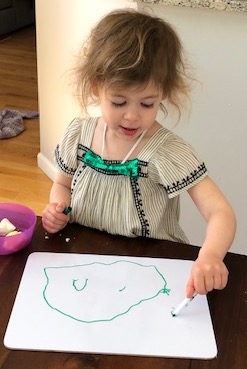
Finally, let’s get to some reassurance. Despite the craziness and exponential amounts of guilt I shouldered this week, clearly not being my best self, we made it to Friday. And our exhaustion and disorientation turned to pure silliness. My 7 year old’s class celebrated a Fancy Friday morning meeting and he wore a button-down shirt with not just a tie, but also a bow tie! (Listening in, I got to hear one classmate question whether leopard print is really fancy like her mom insisted.) One of the twins wanted to get in on the Fancy Friday action, so she wore a sparkly bow tie with her dress. She pretended to have “academic time,” and took out a white board and markers to write some “worms.” (Some misconceptions are just too delightful to correct.)


My 10 year old’s Friday math assignment was to use his own experience to write a word problem. This was what he came up with:


I shared this problem with my actual brother, who happens to be named Sam, who rightfully asked if he was being implicated in a murder. I can’t say for certain one way or the other.

The laughter that has overtaken us today reminds me of the importance of humor right now, just like this therapist noted in her piece entitled, The Toilet is the New Couch. And if sweetness is your jam and you haven’t already seen this amazing video making the rounds, check out this dad reading a bedtime story to his kids, supposedly in the future, about how the world changed for the better because of the virus. We can only hope!

Balancing In-Person and Remote Learning: The Hybrid Model

Most conversations about reopening schools include the hybrid model. This mix of in-person and remote instruction can have many varieties, i...